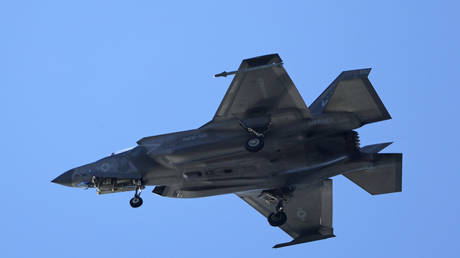
Benjamin Netanyahu is panicking about the sky. The Israeli Prime Minister is making the rounds on American television networks with a very specific, frantic warning for Donald Trump. Do not give Turkey the F-35.
The defense relationship between the US and Israel usually looks rock-solid from the outside. Right now, it's hitting a massive speed bump. Trump wants to mend fences with Turkish President Recep Tayyip Erdogan. Netanyahu sees this as a direct threat to the regional balance of power. The fight isn't just about a stealth aircraft. It's about who controls the airspace of the Middle East for the next three decades.
If you want to understand why a single defense contract has thrown a wrench into US-Israeli relations, you have to look past the official diplomatic talking points.
The Stealth Fighter Friction Between Washington and Jerusalem
Netanyahu used appearances on Fox News and CNN to lay out his case against Ankara. He called Turkey a regime infected by the Muslim Brotherhood. He reminded viewers that Erdogan routinely calls for the destruction of Israel. He even brought up Turkey's occupation of northern Cyprus and its ongoing friction with Greece.
The real issue for Israel isn't Erdogan's rhetoric. It's the radar signature of the F-35 lightning jet.
Israel has built its entire security strategy around a concept called the Qualitative Military Edge. The Pentagon is legally mandated to ensure Israel maintains better military tech than its neighbors. Right now, Israel flies dozens of F-35s. They can slip through Syrian, Iranian, or regional air defenses without anyone knowing. If Turkey gets the same hardware, or even the advanced General Electric F110 engines needed to power Turkey's homegrown fifth-generation KAAN fighter project, Israel loses its unique advantage.
Trump is looking at a different map. Sitting next to Erdogan at the NATO summit in Ankara, Trump openly praised the Turkish leader. He announced plans to lift the CAATSA sanctions that have crippled Turkish defense procurement since 2019. He told reporters he wants to make Erdogan very happy. To Trump, Turkey is a massive NATO ally with a crucial geographic position bordering Russia, Iran, and the Mediterranean. He wants to pull Ankara back into the Western orbit, even if it makes Jerusalem incredibly uncomfortable.
Why Turkey Got Booted From the Program in the First Place
We need to remember how we got here. Turkey wasn't just a buyer for the F-35; it was a core manufacturing partner. Turkish factories built structural parts, display systems, and engine components for every F-35 produced globally.
Everything derailed when Erdogan bought the S-400 missile defense system from Russia.
The Pentagon freaked out. The logic was simple. If Turkey operated both the Russian S-400 radar and the American F-35, Russian technicians could theoretically scan the stealth jet. They could figure out how to track it. Washington gave Ankara an ultimatum. Ditch the Russian missiles or lose the jets. Erdogan refused. Turkey was kicked out of the program, and its industrial contracts were canceled.
Now, Trump wants to override that history. He has signaled that a $700 million deal for jet engines is on the table, alongside a path back to the F-35 program. Vice President JD Vance noted that Congress still has to certify certain legal compliance requirements before any transfer happens. The administration is clearly pushing hard to make the deal happen anyway.
What This Means for Regional Security Moving Forward
If Trump follows through and delivers the stealth technology to Ankara, the ripple effects will shake the Mediterranean.
- Greece will demand parity. Athens is already terrified of Turkish air power and will push Washington for immediate upgrades to its own fleet.
- The Israeli-Turkish cold war will heat up. Trade and diplomatic ties between Jerusalem and Ankara are already at historic lows following the Gaza conflict. A rearmed Turkish Air Force makes an accidental escalation much more dangerous.
- The US Congress will fight back. Lawmakers in Washington are notoriously protective of Israel's military advantage and wary of Erdogan's ties to Moscow.
Netanyahu insists his relationship with Trump is fine. He says they see eye-to-eye on almost everything. The reality is that Trump's transactional foreign policy doesn't always align with Israel's long-term defense doctrines. Trump wants big deals and strong regional partners who can shoulder the burden of local security. Netanyahu wants total regional isolation for Israel's adversaries. Those two goals are officially clashing in the skies over Ankara.
To track how this dispute unfolds, watch the upcoming congressional notifications for defense sales. If the White House formally submits the F-35 components package to Capitol Hill, expect a massive bipartisan battle. Keep an eye on Cyprus and Greece as well. Their diplomatic reactions will tell you exactly how high the regional anxiety is running.