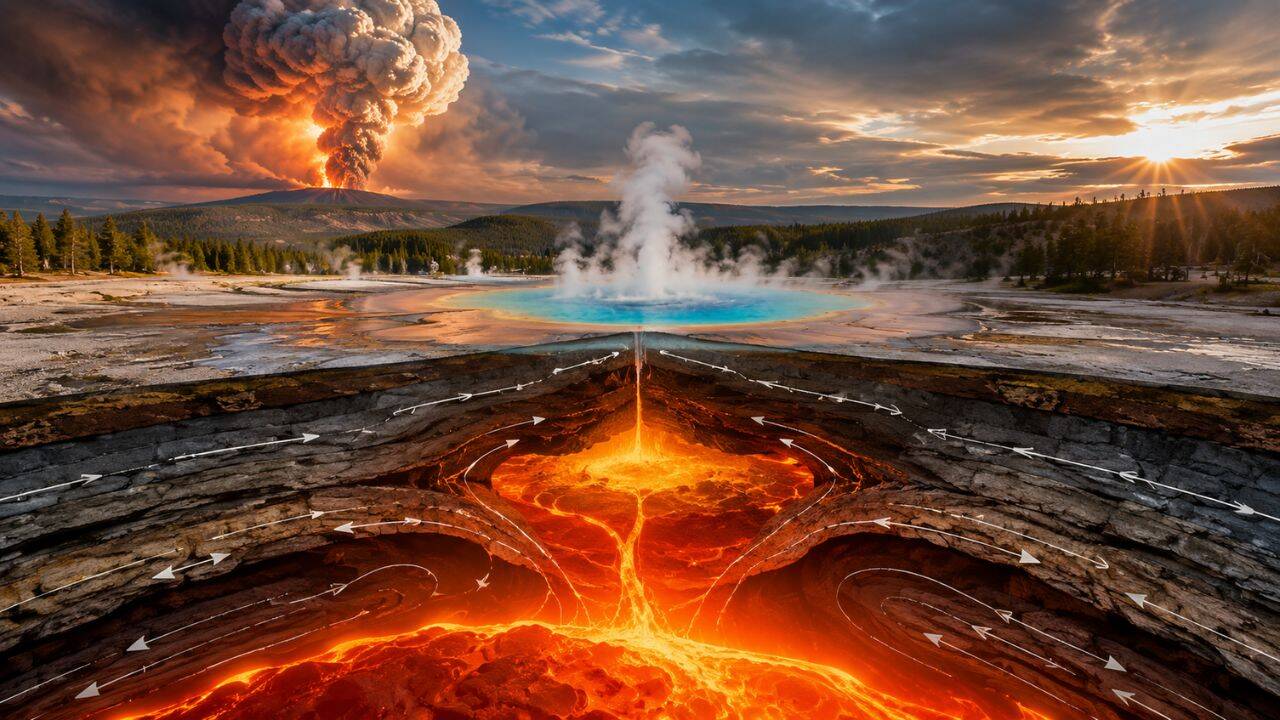
For decades, geologists told us a simple story about Yellowstone. They said a massive column of scorching rock was rising from deep inside the Earth. This column, known as a mantle plume, supposedly acted like a giant blowtorch burning through the North American continent. It sounded terrifying. It made sense.
It was also mostly wrong.
A groundbreaking study published in the journal Science has turned this long-held theory upside down. Researchers used sophisticated three-dimensional computer models to reconstruct millions of years of geological activity across western North America. What they found completely changes our understanding of the magma plumbing system beneath the park. Yellowstone is not being fueled by a deep plume of molten rock rising from the core-mantle boundary. Instead, the real driver is a brutal, underground tectonic tug-of-war happening much closer to the surface.
This discovery clarifies how the legendary Lava Creek eruption happened 640,000 years ago. It explains why the magma moves the way it does. If you want to know what actually keeps this monster alive, you have to look at the crust beneath our feet.
The Old Plume Idea Just Died
The classic textbook explanation for Yellowstone always relied on a hotspot. Think of the Hawaiian Islands. As the Pacific plate moves over a fixed deep-mantle plume, a chain of volcanoes forms. Geologists assumed Yellowstone worked the exact same way. They pointed to a trail of ancient volcanic calderas stretching across Idaho and into Wyoming as proof.
But there was always a glaring problem with this theory. Seismic imaging of the deep mantle under Wyoming never quite matched the clean, vertical pipeline you would expect from a classic plume. The heat source looked messy. It looked fragmented.
Lijun Liu, a prominent geologist at the Institute of Geology and Geophysics at the Chinese Academy of Sciences, decided to test this assumption. His team did not start with the premise that a deep plume must exist. They built a massive simulation using data from ancient plate movements, the current structure of the upper mantle, and the rigid outer shell of the planet.
The simulation spit out an entirely different reality. The traditional plume did not show up as the primary engine. The model demonstrated that the stretching and bending of the North American continent itself generates enough internal stress and heat to melt rock. Tectonic forces alone are doing the heavy lifting here. This means the volcano is a product of shallow, regional structural movements rather than a deep planetary thermal jet.
Enter The Mantle Wind And Tectonic Tug Of War
If a deep blowtorch is not melting the rock, what is? The answer lies in a combination of two massive geological phenomena that are actively fighting each other right beneath the park.
First, you have the lithosphere, which is the crust and the topmost solid mantle. Underneath Yellowstone, this layer is far from uniform. Some chunks are thick and incredibly heavy, while neighboring sections are lighter and thinner. Because of these variations in density, gravity pulls the heavier pieces downward, creating immense internal strain. This uneven weight forces the outer crust to migrate slowly westward toward the Pacific coast.
Second, there is the ghost of an ancient tectonic plate called the Farallon slab. Millions of years ago, this massive ocean plate slid underneath the western edge of North America. It did not just disappear. It is still sinking into the deep mantle today, dragging down the lower parts of the continental crust as it falls.
These two forces do not work together. They pull in completely different directions.
This intense competition literally tears open the lithosphere right beneath Wyoming. As the crust stretches and cracks under the strain, it forms a localized channel. An eastward flowing movement of hot rock in the shallow mantle, called a mantle wind, gets sucked into this open pathway. The hot material rushes upward into the newly formed space, melting the surrounding continental crust and generating the vast reserves of magma that supply Yellowstone.
What Happened 640000 Years Ago
This newly discovered plumbing mechanism provides the missing context for Yellowstone's most famous catastrophic event, the Lava Creek eruption.
Around 640,000 years ago, the ground did not just crack. It violently exploded. The eruption blasted more than 1,000 cubic kilometers of pulverized rock, ash, and toxic gas into the atmosphere. To put that into perspective, the 1980 eruption of Mount St. Helens was a minor blip. Yellowstone's mega eruption was roughly 2,500 times larger. The ash layer was so thick it blanketed most of the western half of North America, choking out sunlight and altering global temperatures.
When that much material leaves an underground reservoir in a short period, the roof can no longer support its own weight. The ground above collapsed inward, creating an irregular oval depression measuring roughly 67 by 42 kilometers. This massive scar is the Yellowstone Caldera.
For years, scientists wondered how such a colossal volume of magma could accumulate and move along a specific southwest-to-northeast track over millions of years. Previous models could not explain why the magma followed that exact path.
The new tectonic model solves that riddle. The shifting shape of the crust naturally guides the rising magma along that specific corridor. The magma did not choose its path randomly. The tectonic tug-of-war carved a highway for it.
Understanding Magma Mush Instead Of Liquid Lakes
People often picture a supervolcano as a gigantic subterranean lake of glowing, liquid lava waiting to burst. Pop culture feeds this image, but it is dangerously inaccurate.
The reality is far less cinematic. The underground reservoir is actually a magma mush system. Think of it like a giant sponge made of solid rock crystals, with pockets of liquid melt trapped in the tiny spaces between those crystals. Most of the time, this mush is highly viscous, sluggish, and completely un-eruptable. It is stuck in place.
For a supereruption to happen, a massive amount of heat must rapidly liquefy this crystal mush, separating the liquid magma from the solid crystals so it can gain enough buoyancy to blast through the surface.
Under the old plume theory, it was difficult to explain how a slow, steady column of deep heat could cause the rapid, massive melting required for a mega eruption. The tectonic model changes that math. Because crustal stresses can shift relatively quickly on a geological timescale, the opening of these underground channels can trigger sudden, intense upward surges of hot asthenospheric rock. This concentrated burst of shallow heat is what liquefies the mush.
Why This Matters For Our Future
Understanding the precise source of Yellowstone's heat isn't just an academic exercise. It completely changes how scientists monitor the park and predict future activity.
If the volcano were driven by a permanent, deep-mantle plume, the heat supply would be essentially limitless and constant. But because it is driven by tectonic forces, the volcano's lifespan is tied directly to the movement of the North American continent.
Geologists note that over the last 17 million years, the active volcanic center has been chewing through relatively warm, thin, and heavily fractured crust. This made it easy for magma to breach the surface. The North American plate is continuously moving southwest. Soon, in geological terms, the volcanic system will slide beneath the much colder, thicker, and harder rock of the craton to the east.
Burning through that thick continental core will require far more energy. Some scientists believe this shift could choke off the volcano entirely, or at least drastically reduce its ability to produce supereruptions.
Right now, the U.S. Geological Survey lists the Yellowstone Volcano Observatory alert level as NORMAL. The aviation code is GREEN. The ground rises and falls by a few centimeters each year, and thousands of tiny earthquakes rattle the park annually. This is just the system breathing. There is zero evidence that a catastrophic eruption is brewing anytime soon. The system has produced about 80 mostly nonexplosive lava flows since the last big blowout, and that remains the most likely scenario for any future activity.
Actionable Steps For Following Volcanic Science
Do not rely on sensationalized tabloid headlines about Yellowstone ending the world. If you want to keep track of real, verified volcanic science, you should look at the primary sources.
First, bookmark the official USGS Yellowstone Volcano Observatory monthly updates. They release a factual summary of deformation, geyser activity, and seismicity on the first of every month.
Second, read the open-access summaries of the new Science paper by searching for the Institute of Geology and Geophysics at the Chinese Academy of Sciences. Following the actual data will save you from unnecessary panic. Tectonic plates move at the speed your fingernails grow, meaning we have plenty of time to watch this monster change.