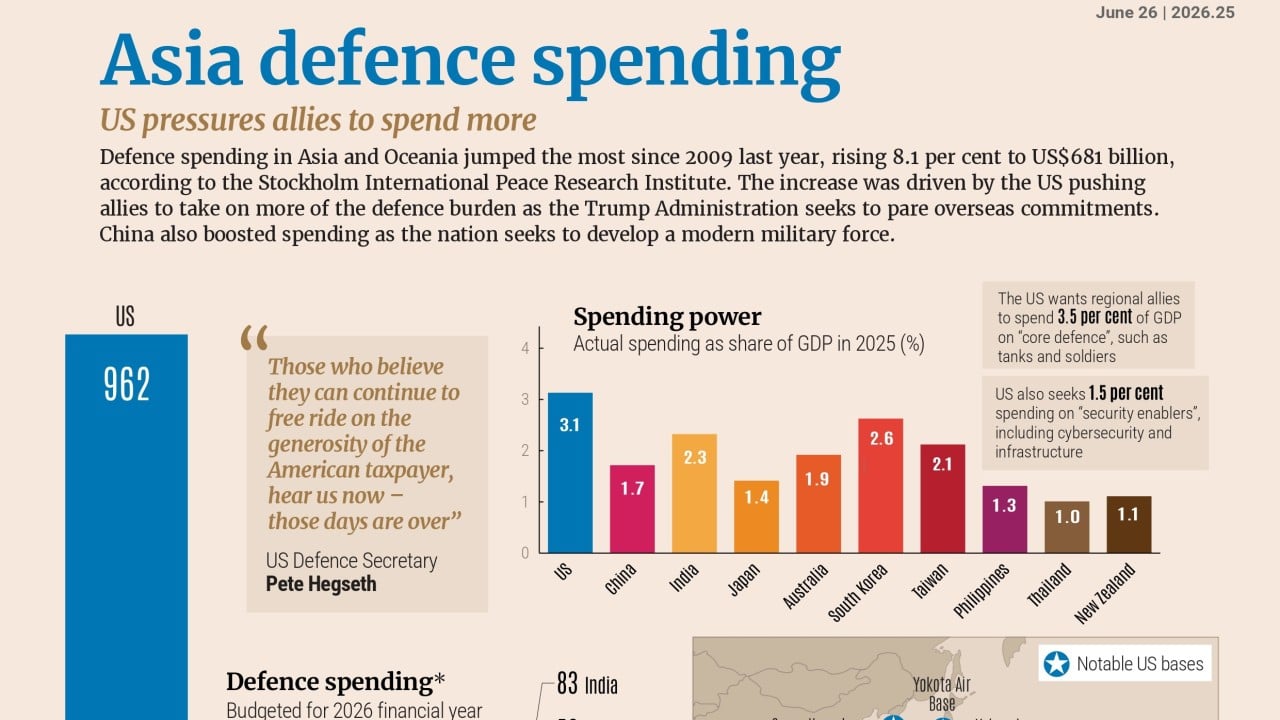
Governments across Asia are buying weapons at a pace we haven't seen since the Cold War. If you look at the raw numbers from the Stockholm International Peace Research Institute (SIPRI) released in April 2026, military spending in Asia and Oceania shot up by 8.1% in 2025 alone, hitting a massive $681 billion. That is the highest annual leap since 2009.
But if you think this is just a simple story of everyone panicking about China, you're missing the real picture.
The mainstream narrative is too neat. It says Beijing spends more, so its neighbors build up their forces, and the cycle continues. While that is true for places like Tokyo and Taipei, it completely ignores the complex realities driving budgets in New Delhi, Jakarta, or Seoul. Asian defense procurement is not a single monolith. It is a fragmented, unpredictable scramble where domestic politics, shifting trust in Washington, and localized rivalries matter just as much as what happens in the Taiwan Strait.
Understanding where this cash is actually going reveals exactly how the regional balance of power is warping.
The Giant Driving the Aggregate Numbers
Let's look at the actual weight of the region's largest spender. China is the undeniable gravity well of Asian defense metrics. The International Institute for Strategic Studies (IISS) notes that Beijing accounts for more than 40% of all military spending in Asia.
According to SIPRI estimates, China poured roughly $336 billion into its military in 2025, marking a 7.4% increase. For 2026, Beijing announced an official defense budget increase of 6.4% in real terms. Even though that represents a slight deceleration from the 8% jumps seen over the last few years, it still outpaces China's expected economic growth rate of 4.5%. It pushes their official threshold past $270 billion.
What makes this striking is the persistence. This is China’s 31st consecutive year-on-year increase. Think about that for a second. Three decades of uninterrupted military expansion.
Even more interesting is what didn't happen. Over the past couple of years, Beijing launched a massive anti-corruption purge targeting military procurement and the Rocket Force. Dozens of generals and defense executives disappeared from public view. In the past, that kind of internal chaos would freeze spending. Not this time. The money kept flowing, ships kept launching, and advanced airframes kept rolling off production lines. Corruption cleanups might change who gets the contracts, but they haven't slowed down the party’s drive for absolute regional dominance.
Washington and the Fear of Being Left Behind
The traditional view says US allies increase spending because they feel secure under the American nuclear umbrella. The reality in 2026 is the exact opposite. Allies are spending because they aren't sure how long that umbrella will last.
Look at Japan. For decades, Tokyo capped its defense budget at a strict 1% of gross domestic product. It was a psychological and political barrier. That barrier is dead. In 2025, Japan's military spending jumped 9.7% to $62.2 billion. That brought it to 1.4% of GDP, its highest level since 1958.
Tokyo is buying long-range Tomahawk missiles from the US and developing its own counter-strike capabilities. They aren't just doing this to be a good partner to Washington. They're doing it because they watched the political paralysis in the US Congress during 2025, where military aid packages were held up for months. Japanese policymakers realized that if a crisis hits the East China Sea, relying solely on American political will is a massive gamble.
Taiwan is facing an even more acute version of this dilemma. Taipei increased its military spending by 14% in 2025, hitting $18.2 billion. For 2026, they announced their budget would reach 3.32% of GDP. That is explicitly designed to match NATO standards.
But the raw numbers hide a major accounting shift. Taiwan achieved that 3.32% figure partly by folding its Coast Guard and Veterans Affairs spending into the defense column. It's a highly political move. Taipei needs to prove to skeptical lawmakers in Washington that it has skin in the game. They are buying time and trying to guarantee US intervention by showing they're willing to bankrupt themselves for their own defense.
Rivalries Independent of Beijing
It's easy to get lazy and blame every dollar spent on China, but that completely misreads South and Central Asia.
India is the fifth-largest military spender on the planet. New Delhi dropped $92.1 billion on its military in 2025, an 8.9% increase. Walk through the procurement choices and you'll see a bifurcated strategy. Yes, they're deploying forces along the disputed Himalayan border with China. But a massive chunk of that budget is going into stockpiling conventional ammunition and expanding domestic production of fighter jets and naval vessels.
India's gaze is permanently locked on two fronts. Pakistan bumped its military budget by 11% in 2025 to $11.9 billion, despite its catastrophic economic troubles. When these two nuclear-armed neighbors watch each other, China becomes secondary. India's goal is to decouple itself from foreign suppliers entirely. They want to avoid a situation where a crisis hits and a foreign capital can cut off their spare parts.
South Korea offers another case where the primary threat isn't China. Seoul's defense budget rose by 2.4% in 2025, but current plans show a massive 7.3% spike for 2026. Why? Because North Korea spent 2025 ripping up peace treaties, testing solid-fuel intercontinental ballistic missiles, and refining its tactical nuclear doctrine. South Korea’s spending is heavily focused on automated defense systems, missile interception networks, and pre-emptive strike capabilities. Beijing is a long-term strategic concern for Seoul, but Pyongyang is an existential threat that could trigger tomorrow morning.
The Boom and Bust of Southeast Asia
Southeast Asian defense spending is a wild card. It doesn't follow a smooth upward curve. Instead, it moves in jagged, volatile bursts driven by short-term fiscal space and immediate procurement cycles.
Take Indonesia. In 2025, Jakarta shocked regional analysts by increasing its defense budget by an astonishing 27% in real terms. It looked like a massive rearmament drive. But it wasn't a sudden panic over the South China Sea. It was simply the peak of a long-delayed procurement payment cycle. The government finally signed off on big-ticket items like Rafale fighter jets and naval upgrades, causing procurement to swallow 30% of the entire defense budget.
What happened next? For 2026, Indonesia’s defense budget is projected to drop by roughly 27% in real terms, resetting right back to its pre-2025 levels. It’s an economy-driven cycle, not a threat-driven one.
Meanwhile, the Philippines increased its real-term defense budget by 4.2% for 2026. They are pushing forward with their Re-Horizon 3 modernization plan. Unlike Indonesia, Manila's spending is directly tied to territorial friction. They are moving away from internal security operations against insurgents and putting their money into maritime patrol aircraft, anti-ship missiles, and radar stations along the western coast.
The Economic Limiters
You can't spend money you don't have. The World Bank expects regional economic growth in Asia to slow down from 5.0% in 2025 to 4.2% in 2026. This slowdown is going to create severe fiscal friction.
Most Asian nations are not military dictatorships; they have to balance defense with social spending, infrastructure, and aging populations. Thailand and Malaysia are classic examples. Both countries face serious fiscal constraints and have chosen to postpone major military acquisitions to prioritize domestic economic recovery. Malaysia's defense budget hovers around $9.9 billion, and Thailand sits at $11.3 billion. Neither is willing to sacrifice economic stability to join a regional arms race that they feel they can't win anyway.
Even China is feeling this pressure. The decision to set the 2026 official defense budget growth at 6.4% instead of pushing past 8% shows that the leadership in Beijing is mindful of local government debt, property sector weakness, and youth unemployment. They want a powerful military, but they know that an economic implosion at home would destroy the party faster than any foreign adversary could.
How to Track the Real Shifts Moving Forward
If you want to understand where this region is heading, stop looking at total budget announcements. They don't tell the whole story. Instead, focus on these specific markers over the next twelve months.
First, look at the ratio of personnel costs to procurement. A country that spends all its money on soldier salaries is not building a projection force. A country that cuts personnel to buy autonomous drones, anti-ship cruise missiles, and long-range radar is preparing for high-intensity warfare. Watch Taiwan and Japan on this front.
Second, monitor domestic production mandates. India, Australia, and South Korea are trying to build self-sustaining defense industrial bases. If they succeed, they become independent actors. If they fail, they remain dependent on Washington or European suppliers, which limits their strategic options during a crisis.
The Asian arms buildup is real, but it is uneven, deeply political, and limited by economic reality. Don't fall for simple headlines. Look at the specific vulnerabilities each nation is trying to buy its way out of.



.jpg)