NATO just got caught completely flat-footed. For 18 months, uninvited guests flew directly over Europe's most sensitive military infrastructure, and nobody did a thing about it.
A damning report by the International Institute for Strategic Studies (IISS) confirms what intelligence insiders feared. Between late 2024 and mid-2026, Russian intelligence orchestrated a massive, coordinated drone surveillance campaign. They logged 144 separate incursions across more than a dozen countries. The primary targets weren't random power plants or public parks—they were NATO's ultimate deterrents: nuclear submarine bases, airbases housing American nuclear warheads, and critical civilian airports.
The worst part? European militaries watched it happen. Not a single drone was shot down or captured. Russian operatives operated with near-total impunity, exploiting a massive gap in Western air defenses that officials have only quietly admitted until now.
The Shadow Fleet Shadowing Europe's Nukes
You don't just pack a long-range military drone in a suitcase and fly it from a hotel balcony. The IISS investigation revealed exactly how the Kremlin bypassed land borders. They used the "shadow fleet"—the messy, unregulated web of commercial tankers and cargo ships that Moscow uses to dodge Western oil sanctions.
Operatives from Russian private military contractors took over these vessels, turning them into mobile, seaborne launchpads. By operating in international waters with their transponder tracking devices switched off—a tactic known as "dark sailing"—they got close enough to launch unmanned aerial vehicles (UAVs) right into sovereign European airspace.
The digital footprints and maritime logs tie specific ships to major security breaches:
- RAF Lakenheath (Suffolk, UK): In late November 2024, large, non-hobby drones swarmed this base just as it was being prepared to house US nuclear weapons. The IISS suspects the drones were piloted from either the Seasons 1 tanker floating in the North Sea or the Hav Dolphin, a cargo ship docked at Hull.
- Île Longue (Brittany, France): In December 2025, five heavy drones breached the airspace over France’s primary sea-launched nuclear ballistic missile base. At the exact same time, three Russian-linked shadow fleet vessels sat just 60 to 120 miles offshore.
- Kleine-Brogel (Belgium) & Volkel (The Netherlands): In late 2025, back-to-back drone swarms targeted these airbases, both of which store air-launched US nuclear weapons. Again, shadow fleet tankers were tracked idling in nearby international waters.
Why Didn't Anyone Shoot Them Down?
It's the obvious question. If a hostile foreign power flies a drone over a nuclear base, why don't you blast it out of the sky?
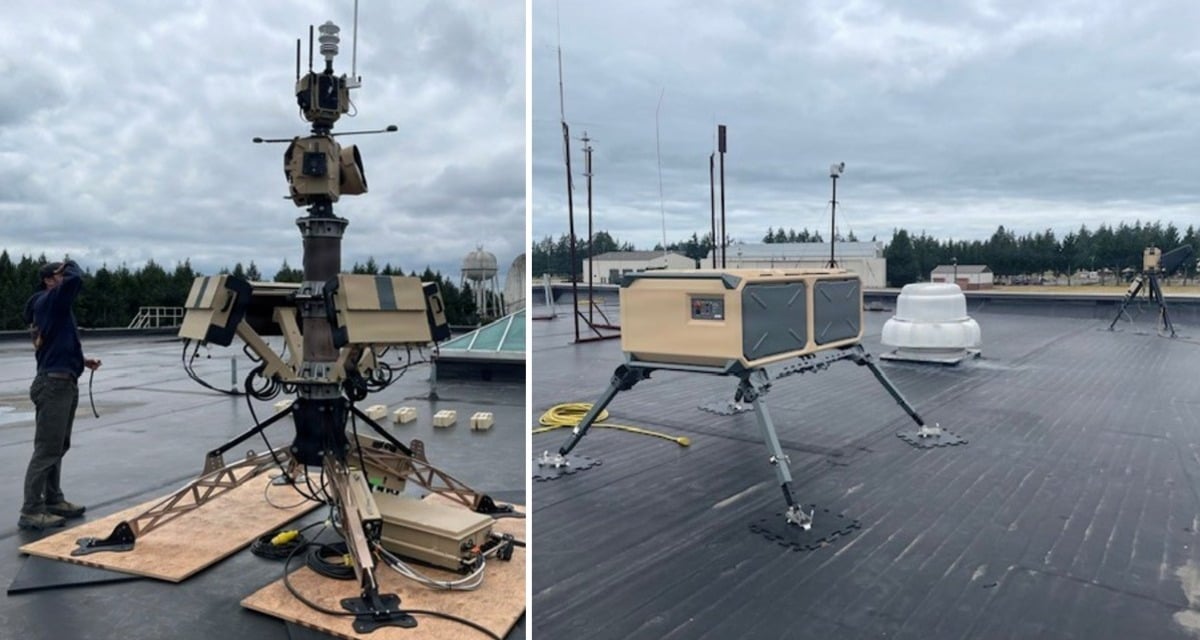
The reality reveals how outdated Western air defense doctrines actually are. NATO's multi-billion-dollar defense systems are built to detect high-altitude bombers, cruise missiles, and fast-moving fighter jets. They aren't calibrated for small, low-flying, slow-moving plastic drones that look like a flock of birds on a radar screen.
There's also the legal and kinetic nightmare of "collateral damage." Firing traditional anti-air missiles or heavy ammunition over populated European territory poses a massive risk to civilians. When guards at the Volkel Air Base in the Netherlands actually opened fire on ten drones in November 2025, they missed entirely. No wreckage was ever recovered.
Furthermore, the Russians didn't just fly basic off-the-shelf quadcopters. In places like Kleine-Brogel, the incursions happened in distinct, highly sophisticated phases. First, they sent small drones to test local radio frequencies and map defense reactions. Then, they brought in larger, higher-altitude military UAVs equipped with advanced jamming pods. When local forces tried deploying electronic counter-jammers, the Western tech failed to break the Russian signals.
Psychological Warfare and Economic Attrition
The Kremlin's goals go far beyond simple photography. Satellites can already take pictures of buildings. Drones, however, offer real-time, low-altitude imagery, allowing Russian intelligence to monitor guard shift rotations, track specific security upgrades, and analyze physical vulnerabilities.
But the real value for Moscow was psychological warfare. By repeatedly forcing the closure of critical infrastructure—like the September 2025 incident that paralyzed Copenhagen Airport and other Danish hubs—Russia proved it could inflict millions of dollars in economic attrition without firing a single bullet. They purposely stayed below the threshold of kinetic war, making it impossible for NATO to cleanly trigger Article 5 collective defense. It was a masterclass in grey-zone harassment.
What Happens Next: Fixing the Blindspots
The peak of the drone incursions occurred in late 2025, but the threat has only shifted, not disappeared. European navies finally started aggressively seizing shadow fleet vessels in early 2026, which caused the maritime drone launches to drop. However, the underlying vulnerability remains completely unaddressed.
If European nations want to stop being helpless observers in their own skies, the next steps require a massive shift in procurement and legal frameworks:
- Fund the European Drone Wall: The EU's proposed flagship defense projects—the European Drone Wall and Eastern Flank Watch—need immediate, unified funding rather than bureaucratic bickering over costs. Airspace security can no longer rely purely on heavy missile batteries.
- Authorize Peacetime Drone Shoot-downs: Mimic the hardline stance taken by Lithuania and Poland. Military personnel need clear, peacetime rules of engagement that allow them to use directed-energy weapons, net-guns, or targeted electronic warfare against unauthorized UAVs instantly, without waiting for political clearance.
- Aggressive Maritime Interdiction: Tighten the legal loop on "dark sailing." Any commercial ship turning off its transponder in the North Sea or English Channel should be treated as a direct security threat and boarded immediately by coastal navies.
Relying on standard air defense paradigms won't cut it anymore. If NATO doesn't adapt its tactics to counter low-cost, sea-launched drone tech, the next 18 months will look much worse than the last.