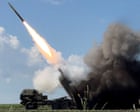
The illusion has finally cracked. As leaders gather in Ankara for the latest Nato summit, a brutal reality dominates the corridors. Europe faces up to the prospect that the US may be unable to arm Nato allies, and it's not just a political choice by the Trump administration. It's a hard math problem. The American defense industrial base is running on empty.
Decades of outsourcing, just-in-time manufacturing, and two simultaneous, high-intensity conflicts have drained American warehouses. The wars in Ukraine and Iran have eaten through stockpiles at a rate Western planners never anticipated. Now, European capitals are waking up to a terrifying bottleneck. They are standing in a long line for weapons that simply do not exist.
The immediate consequences are already measured in human lives. Just yesterday, a brutal wave of Russian strikes hammered Kyiv, leaving at least 21 people dead. Ukrainian President Volodymyr Zelenskyy pointed out the stark truth. The missiles got through because Ukraine ran out of interceptors. The world’s greatest superpower can no longer build weapons fast enough to protect its friends.
The Empty Arsenals Behind the Ankara Summit
The fundamental issue is supply. The US military machine is facing structural exhaustion. For the second year in a row, President Donald Trump is demanding that European allies increase their defense spending to an unprecedented 5% of GDP. He wants them to buy American. But there is a glaring contradiction in this demand. Even if European nations write the checks, Washington cannot deliver the hardware.
Key shipments of high-end weaponry to Europe are already delayed or canceled. Germany was supposed to receive Tomahawk cruise missiles. Those plans are now aborted. The reason is simple. The US fired roughly 1,000 Tomahawks during the conflict in Iran. They are gone. You can't ship weapons you don't have.
The shortages stretch across the entire spectrum of modern warfare.
- PAC-3 Patriot Missiles: The US used an estimated 50% of its total PAC-3 stockpile through April of this year alone, primarily dealing with the conflict in Iran. About 20 countries are now waiting in line for Patriots.
- HIMARS Rocket Artillery: Mobile rocket launchers, which proved vital on the Ukrainian front lines, face massive production backlogs.
- Tomahawk Cruise Missiles: Depleted by deep-strike campaigns in the Middle East, leaving European deterrence strategies hollow.
Why Europe Is No Longer Customer Number One
European diplomats are quietly seething, though they won't say it openly. They want to avoid a total collapse in transatlantic relations. But behind closed doors, the mood is grim. Europe knows it has dropped down the priority list.
When the US has a finite amount of ammunition, someone loses out. Right now, European security is taking a back seat to two other priorities. First, the immediate resupply of active combat zones like Israel and the Middle East takes precedence. Second, Washington is desperately trying to save resources for a potential conflict with China in Asia.
Think about the math on the Patriot missile system. The Center for Strategic and International Studies estimates it would take 42 months for the US to replenish just its own internal stockpiles of these missiles. That is nearly four years of waiting just to get back to baseline. If you are a European nation looking to secure your skies against a resurgent Russia, you are looking at years of extreme vulnerability.
The Dangerous Strategic Gap
This leaves Western Europe in an incredibly precarious position. It takes time to build factories. European defense companies estimate it will take five to ten years to establish new, independent production lines for advanced missiles and artillery.
The timing could not be worse. The Trump administration is eager to pull US troops and critical capabilities out of Europe sooner rather than later. This creates a dangerous strategic vacuum. Russia knows the timelines. Moscow understands that Europe’s rhetoric about strategic autonomy does not match its industrial capacity.
We are seeing a major policy failure unfold in real time. For years, European nations treated defense spending as an optional luxury. They assumed the American umbrella would always be there. Now, the umbrella has been diverted to other storms.
Fixing the Long-Term Industrial Failure
So, what happens next? Writing bigger checks to Washington won't fix this. The solution requires a fundamental shift in how Europe views its own survival.
First, European leaders must stop trying to buy off-the-shelf American systems that have multi-year waiting lists. They need to invest directly in domestic co-production. There are small signs of movement here. The Trump administration has hinted at sideline announcements in Ankara regarding joint factories and shared production lines built on European soil. This is a start, but it needs massive scale.
Second, standardizing European military hardware is urgent. Right now, the continent operates too many different types of tanks, fighter jets, and missile systems. This fractures the supply chain. If Europe wants to survive the next decade without American hand-outs, it must build a unified, simplified defense industry.
The era of relying on Uncle Sam for ammunition is over. The US is tapped out, distracted, and spent. Europe must learn to arm itself, or accept that its security will be dictated by its adversaries.