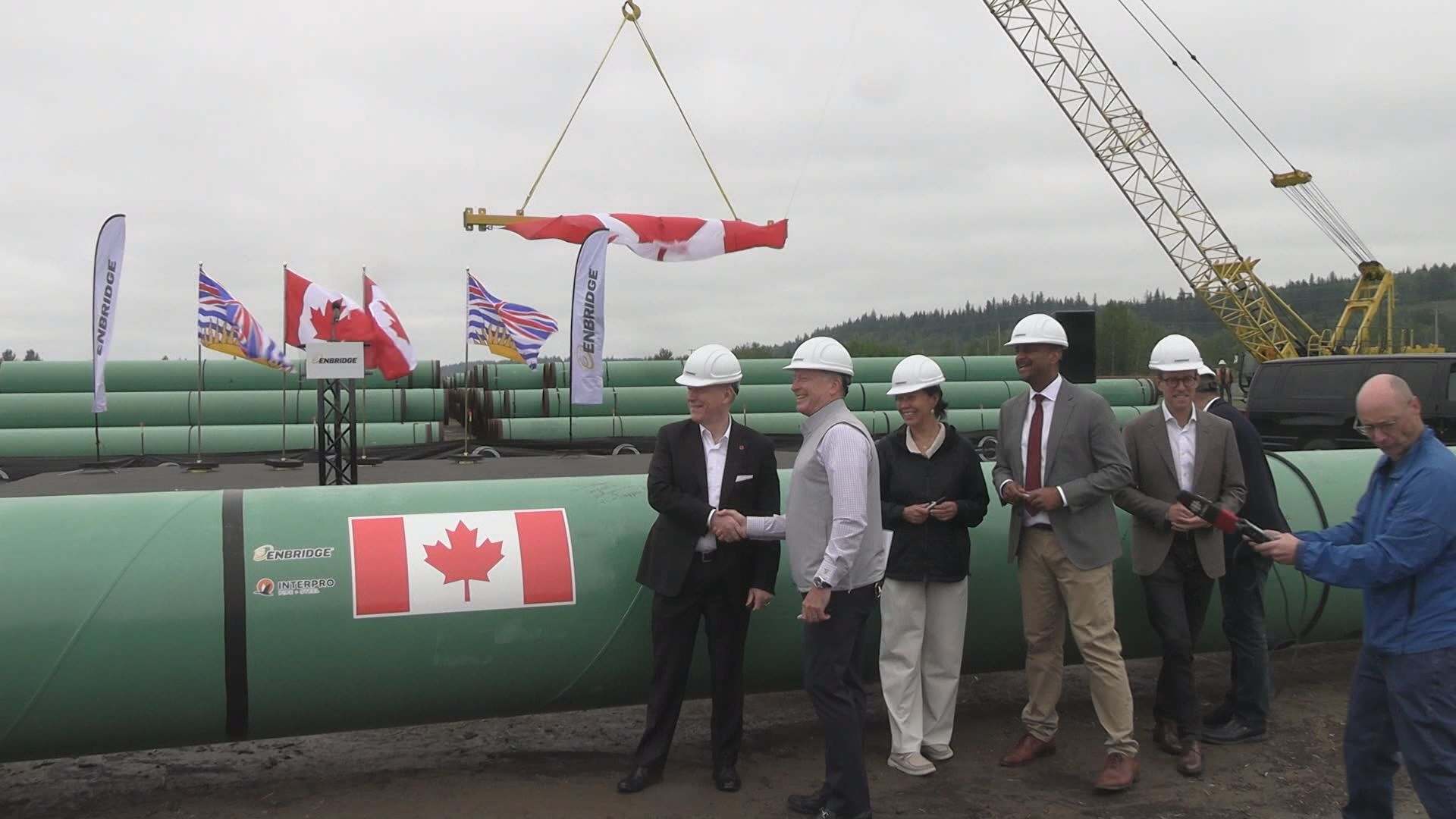
Ground has officially broken on the $4-billion Enbridge Sunrise pipeline expansion near Prince George. If you follow Canadian energy developments, you know major infrastructure projects usually get bogged down in years of regulatory delays, legal appeals, and political stalling. This one didn't. The federal government approved the project in April 2026, and by July 2026, crews were already laying out massive 42-inch steel pipes at the stockpile site in Prince George.
That three-month turnaround from final regulatory clearance to heavy equipment hitting the ground is almost unheard of in modern Canadian resource development. But speed isn't the only reason this project deserves a closer look. Discover more on a connected issue: this related article.
The expansion addresses two urgent pressures facing Western Canada simultaneously: a severe manufacturing downturn in Northern British Columbia and a surging demand for natural gas across domestic heat, electricity generation, and West Coast export terminals.
Here is what is actually happening on the ground, why the project moved so fast, and what the numbers reveal about its real-world impact. More reporting by Forbes explores related perspectives on this issue.
The Scope of the Construction Work Around Prince George
The Sunrise Expansion Program isn't an entirely new corridor carved through untouched wilderness. Instead, it's a massive upgrade to Enbridge's existing Westcoast Pipeline system, a 2,900-kilometre transmission network that has moved natural gas across B.C., Alberta, and into the U.S. Pacific Northwest for decades.
Engineers refer to this approach as "looping". Think of it like adding extra lanes to a congested two-lane highway. Enbridge is building roughly 140 kilometres of brand-new, 42-inch-diameter steel pipe divided across 11 distinct looping segments. These new pipe sections run directly parallel to the current right-of-way between Chetwynd and the southern border.
Alongside the new pipe, the project requires major mechanical overhauls. Gas pressure drops over long distances due to physical friction inside the pipe walls. To keep natural gas flowing smoothly at capacity, Enbridge is upgrading compressor stations along the line, including key facilities at Azouzetta Lake, Summit Lake, 93 Mile, Kingsvale, Othello, and Hixon.
Crucially, three of the four new compressor units will run entirely on electricity rather than burning natural gas fuel. That structural choice requires constructing roughly 10 kilometres of new overhead electrical transmission lines to tie the stations into the provincial grid. Electric drive units run dramatically quieter than traditional gas-fired turbines and slash operational emissions directly at the site.
When construction wraps up in late 2028, the expanded network will carry an additional 300 million cubic feet per day (MMcf/d) of natural gas. That added volume carries enough energy potential to generate two gigawatts of electricity—roughly equivalent to powering 1.5 million Canadian homes every single day.
Economic Timing and Northern B.C. Workforce Reality
To understand why local political leaders in Prince George greeted this construction announcement with relief, you have to look at what happened in the region just days before the groundbreaking ceremony.
Forestry giant Canfor announced the permanent closure of its Northwood pulp mill in Prince George. That single decision wiped out 300 high-paying industrial jobs overnight. For a city that has long served as the supply hub for B.C.'s interior forestry sector, the economic blow was immediate and severe.
The pipeline project doesn't solve structural forestry challenges, but it provides an immediate economic safety net for skilled tradespeople in the region.
During peak construction, the Sunrise project requires a massive workforce.
- About 1,300 workers will be hired directly within Northern B.C.
- Total provincial employment will top 2,300 jobs across specialized construction and engineering roles.
- Nationwide, supporting supply chains and manufacturing will support around 2,500 jobs.
To house more than 800 workers assigned to remote segments north of McLeod Lake, temporary worker accommodations are being established around Mackenzie and the Pine Pass corridor. Closer to urban centers like Prince George, workers will stay in local hotels and utilize regional services, pouring consumer spending directly into local restaurants, equipment rental yards, and transport providers.
The macroeconomic projections are substantial. Project organizers estimate the construction activity will add over $3 billion to Canada's gross domestic product and yield $700 million in federal, provincial, and municipal tax revenue. Local government entities in Fraser-Fort George will use these tax revenues to help fund public infrastructure, regional road repairs, and local public services.
Domestic Supply vs. LNG Export Markets
Where will all that extra natural gas actually go once the valves open in late 2028?
A widespread misconception about West Coast pipeline construction is that every cubic foot of expanded capacity goes straight onto ocean tankers bound for foreign markets. The reality here is balanced roughly fifty-fifty.
Enbridge projects that approximately half of the new 300 MMcf/d capacity will stay right inside B.C. It will meet rising residential heating needs, power regional utility generation, and feed manufacturing operations in the lower mainland and interior regions. The remaining half will move south to serve utility customers in the U.S. Pacific Northwest and supply emerging LNG export facilities along B.C.'s coastline.
Among those export outlets is the Woodfibre LNG project near Squamish, where Enbridge holds a 30 percent equity stake. Designed as a net-zero facility using electric drive technology, Woodfibre LNG relies on predictable upstream supply from systems like the Westcoast line to meet its export commitments.
By connecting northern B.C.'s vast gas reserves directly to southern demand centers, the expansion stabilizes energy deliverability across the province. During extreme winter cold snaps, energy demands on B.C.'s grid spike rapidly. Having additional pipeline capacity ensures natural gas power plants can fire up without risking supply shortfalls for home heating.
The Steel Supply Chain and Domestic Sourcing
One notable aspect of the Sunrise Expansion is where its materials originate.
Typically, large-diameter pipeline builds import a substantial portion of their heavy steel pipe from overseas mills in Asia or Europe to shave costs. The Sunrise project took a different route. Every piece of 42-inch pipe lined up in the Prince George staging yard consists of 100 percent Canadian melted and poured steel.
The primary supplier for the project's heavy structural pipe is InterPro Pipe + Steel, operating out of Saskatchewan. Procurement for the project supported more than 600 manufacturing and steelworking jobs at their facilities.
Using domestic steel keeps capital expenditure dollars within the Canadian economy. It also shields the project timeline from global shipping bottlenecks, maritime port congestion, and international trade disputes that have delayed other major energy builds across North America in recent years.
Equity Ownership and First Nations Partnerships
Perhaps the most significant structural change in how energy infrastructure gets built in Western Canada involves financial alignment with First Nations communities.
Rather than relying solely on traditional consultation and short-term benefit agreements, the Westcoast Pipeline system features direct Indigenous equity ownership. In 2025, an alliance representing 38 First Nations in British Columbia acquired a 12.5 percent equity stake in the existing Westcoast pipeline network.
That historic deal was backed by a $400 million federal loan guarantee issued under the Indigenous Loan Guarantee Program, facilitating a total investment of $736 million.
Because these 38 communities hold an equity stake in the underlying asset, they participate directly in long-term revenues generated by transmission volumes across the network. While First Nations equity partners aren't forced to take on additional capital obligations for the expansion itself, they retain options to participate in growth developments as project construction proceeds toward completion.
Local leadership, including Lheidli T'enneh First Nation Chief Dolleen Logan, attended the official groundbreaking alongside corporate executives and government ministers. This collaborative operational framework explains why the project moved smoothly through the federal assessment pipeline without landing in courtrooms.
Environmental Mitigation and On-Site Reality
Building 140 kilometres of new heavy pipe along B.C.'s rugged terrain presents environmental hurdles. Crossing streams, navigating steep mountain passes like Pine Pass, and working near fish-bearing waterways requires stringent environmental mitigation practices.
Before ground disturbance began in mid-2026, field crews spent over two years conducting geotechnical, archaeological, and biological field studies. These teams mapped out local wildlife habitats, wetland boundaries, and watercourse hydraulics across every segment.
Where the pipeline route crosses sensitive rivers or salmon streams, construction crews employ horizontal directional drilling (HDD). HDD allows engineers to bore a tunnel deep beneath the riverbed and pull the pipe through without disturbing the surface soil, stream banks, or aquatic habitats above.
On land, crews clear the right-of-way, grade the soil, and temporarily stockpile topsoil off to the side. Once the 42-inch pipe is welded, non-destructively inspected via X-ray or ultrasound, coated, and lowered into the trench, the soil is backfilled. Reclamation crews then re-contour the surface, re-establish natural drainage patterns, and seed native vegetation to return the corridor to its original state.
The transition to electric-driven compressor units at key stations further limits long-term atmospheric emissions. By utilizing B.C.'s hydro-dominated electrical grid for station operations, Enbridge eliminates a major source of operational Scope 1 greenhouse gas emissions that traditionally accompanied pipeline compression.
Key Technical Specifications Summary
To put the scale of the $4-billion expansion into perspective, here is a quick breakdown of its core engineering numbers:
- Total project capital expenditure: $4 billion
- Total new pipeline length: Approximately 140 kilometres across 11 looping segments
- Pipe diameter: 42 inches
- Additional transmission capacity: 300 million cubic feet per day (MMcf/d)
- Targeted in-service date: Fourth quarter of 2028
- Direct construction workforce: 1,300 local jobs in Northern B.C., 2,300 across the province
- Primary pipe supplier: InterPro Pipe + Steel (100% Canadian melted and poured steel)
- Indigenous equity interest: 38 First Nations holding 12.5% ownership in the Westcoast pipeline system
What Happens Next for the Sunrise Pipeline Project
Heavy machinery is already active along access roads and staging yards near Prince George, Hixon, and Summit Lake. Site clearing, grading, and foundation preparation for new compression facilities will occupy crews throughout the remainder of 2026.
Pipe stringing, trenching, and welding will pick up momentum as construction seasons open up through 2027 and early 2028. Hydrostatic pressure testing of the completed loops will follow before final tie-ins to the active line are authorized.
If you are a local contractor or skilled worker looking to participate in the project:
- Connect directly with prime contractors managing active segments around Prince George, Chetwynd, and Mackenzie.
- Verify trade certifications, safety tickets, and environmental orientation requirements specific to linear pipeline construction in B.C.
- Monitor regional procurement portals where local sub-contracts for clearing, hauling, catering, and accommodation support are regularly listed.
The Sunrise Expansion proves that when industry, local communities, federal authorities, and First Nations align around economic goals and environmental standards, major infrastructure can move from approval to active construction without getting stuck in endless political gridlock.