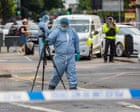
A quiet Saturday afternoon on a busy London high street can change in a split second. At 2:29 PM on June 27, 2026, panic hit Ealing Broadway. A white car ploughed into multiple pedestrians outside the station, sending bystanders scattering and leaving five people injured.
Online footage captured the chaotic seconds of the incident. It showed terrified and angry witnesses running alongside the vehicle, kicking at the bodywork, and desperately trying to yank open the driver’s side door. Instead of stopping, the car accelerated and sped away from the bloodied pavement.
The Metropolitan Police didn't take long to act. Within a short time, officers tracked down and intercepted the vehicle in nearby Grange Park. The driver, 34-year-old Timir Ahmed Mohamed, was arrested. By Sunday evening, the Crown Prosecution Service escalated the situation significantly, charging Mohamed with five counts of attempted murder.
The Charges Facing Timir Ahmed Mohamed
When a vehicle hits a crowd in the UK, the legal system has a massive decision to make. Many drivers who hit pedestrians face charges of dangerous driving or causing serious injury by dangerous driving. Attempted murder is a completely different beast.
To secure an attempted murder charge, prosecutors must believe they can prove a specific element. The driver didn't just drive badly; they intended to kill.
The Met Police confirmed the full list of charges against Mohamed, a Somalia-born British citizen living in Grange Park, Ealing. It paints a picture of a major escalating incident.
- Five counts of attempted murder: One count for each pedestrian struck on the pavement.
- Dangerous driving: Reflecting the nature of the vehicle's movement through Ealing Broadway.
- Failing to stop: Because the driver fled the scene while bystanders tried to intervene.
- Failing to provide a specimen of breath for analysis: Indicating suspicion of impairment at the time of the arrest.
- Criminal damage: Relating to the destruction caused during the event.
Mohamed has been remanded in custody. He's scheduled to face Willesden Magistrates' Court on Monday, June 29, 2026.
Why Counter Terrorism Policing Stepped In
Whenever a car mounts a pavement and strikes pedestrians in a major capital city, alarm bells ring at Scotland Yard. The tactic mirrors several high-profile terrorist attacks across Europe over the last decade.
Because of this, local Ealing officers immediately looped in Counter Terrorism Policing London. Specialist anti-terror investigators took over the initial stages of the inquiry, analyzing the suspect’s background, digital footprint, and immediate movements before the crash.
They looked for signs of ideological radicalization or political motives. After an intense 24-hour review, the Met announced that while detectives are keeping an open mind about why this happened, the incident is officially not being treated as terrorism.
The investigation remains with local borough detectives, handled as a targeted or heavily reckless criminal act rather than an act of violent extremism.
The Condition of the Victims
The emergency response on Saturday afternoon was massive. The London Ambulance Service flooded Ealing Broadway with paramedics, fast response cars, and an incident response officer. They even dispatched London’s Air Ambulance, landing a helicopter nearby to handle potential trauma cases.
Five pedestrians were caught in the path of the car.
The outcome could have been much worse. Two of the injured were treated by paramedics right on the high street and didn't need a hospital bed. The other three were rushed to a major trauma centre and local hospitals.
On Sunday, medical staff confirmed that none of the victims sustained life-threatening or life-changing injuries. They are expected to recover physically, though the psychological trauma of being hunted by a vehicle on a weekend shopping trip will linger.
What Happens Next in the Legal Process
This case will move quickly through the early court stages before settling into a long trial preparation phase.
When Mohamed appears at Willesden Magistrates' Court on Monday, the hearing will be brief. Magistrates do not have the legal powers to try attempted murder cases. The case will be formally sent to the Crown Court—likely the Old Bailey or Harrow Crown Court—where a judge will set dates for a plea hearing and an eventual trial.
Because Mohamed was remanded in custody by the police, his defense team would need to make a formal bail application to a Crown Court judge to get him released before trial. Given the five attempted murder charges, bail is highly unlikely.
Police forensic teams spent Sunday gathering physical evidence on Ealing Broadway, mapping tire tracks, and inspecting the damaged white vehicle. Detectives are still urging anyone who witnessed the event, or who holds dashcam and mobile phone footage, to call 101 and quote reference 4607/27JUN.

:max_bytes(150000):strip_icc()/TAL-nassau-bahamas-BEAUTCARIB0323-4fbfce903e5a4418b895e03717e3de0d.jpg)