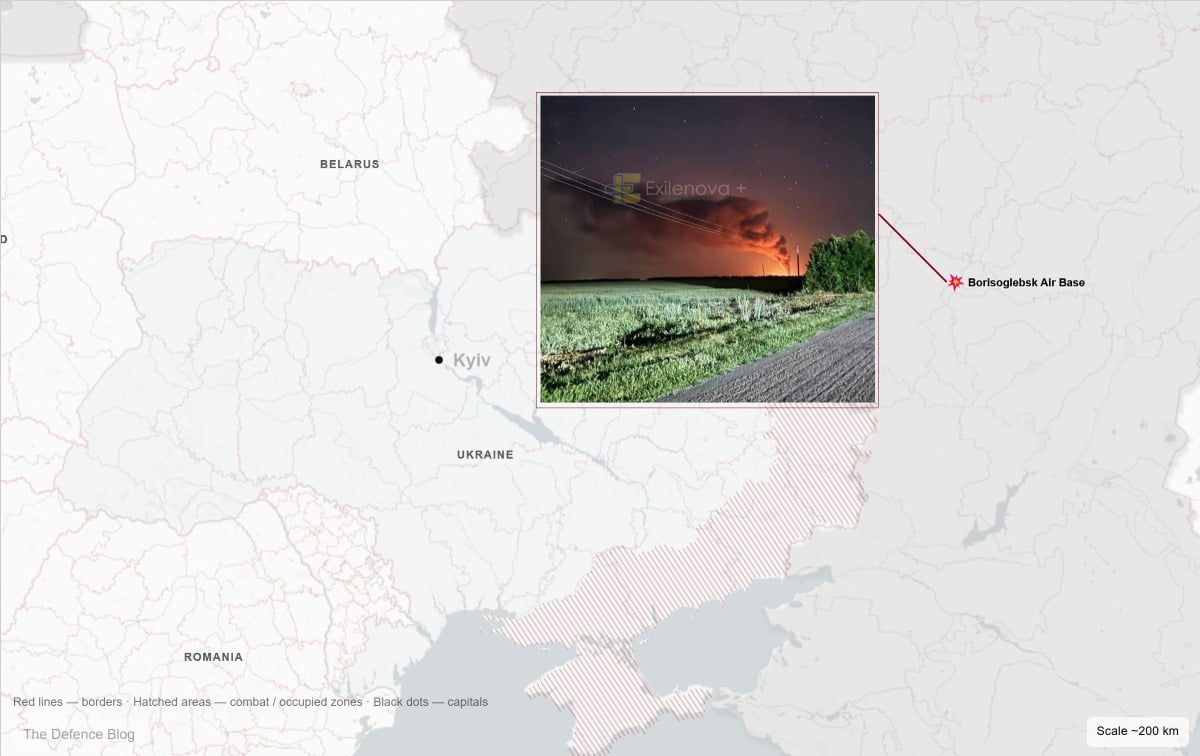
Russia just learned a brutal lesson about leaving expensive toys out in the open. Overnight on July 8, 2026, Ukrainian long-range drones slammed into the Borisoglebsk military airbase in the Voronezh region, sparking massive fires that lit up the night sky.
While Moscow’s official channels naturally tried to downplay the incident, the data doesn't lie. Local Telegram channels filled up with frantic eyewitness videos showing thick smoke columns rising from the facility. Worse for the Kremlin, NASA’s Fire Information for Resource Management System (FIRMS) flagged major thermal anomalies directly inside the base.
The real kicker? Satellite imagery caught Russia parking seven ultra-expensive Su-35 fighter jets right in the open just hours before the attack.
This wasn’t a random lucky shot. It’s a calculated hit on a critical hub.
The Exposed Target at Borisoglebsk Airbase
If you look closely at how the Russian Aerospace Forces operate, Borisoglebsk isn't just another landing strip. Located roughly 300 kilometers from the Ukrainian border, it serves a dual purpose. It’s the home of the 783rd Aviation Training Center, where Russia grooms its next generation of frontline bomber and ground-attack pilots.
But more importantly for the current war effort, it acts as a forward refueling and rearming point for the 105th Mixed Aviation Division.
When Russian Su-34 fighter-bombers and Su-35 fighters want to launch guided glide bombs without burning through all their fuel flying from deep within Russia, they stop here. They patch up, fill the tanks, load ordnance, and take off.
Publicly available OSINT data from Militarnyi confirmed that on July 7, 2026—the day before the drones arrived—the base was packed. The lineup included:
- 7 Su-35 combat fighters
- 8 Yak-130 trainer aircraft
- 2 Mi-8 series helicopters
- 1 massive Mi-26 heavy transport helicopter
They were parked closely together in standard, unarmored parking spaces. No hardened shelters. No reinforced concrete pens. Just millions of dollars of sophisticated hardware sitting like sitting ducks.
What Burned and Why it Hurts Moscow
According to flight and fire monitoring data, the primary heat signatures flared up precisely where the Su-35 fighter jets were parked and near the base's fuel storage tanks.
When a long-range drone hits a fuel farm, the resulting fire isn't something you put out with a few hand extinguishers. It creates a cascading thermal crisis. Even if a fighter jet isn't hit directly by shrapnel, the intense ambient heat from a nearby fuel fire can warp airframes, destroy sensitive electronics, and ruin complex radar systems inside the nose cones.
This isn't Ukraine’s first rodeo at this specific base either. Back in July 2025, Ukrainian forces hit Borisoglebsk and wrecked a storage facility housing Universal Gliding and Correction Modules (UMPK)—the exact kits Russia uses to turn dumb bombs into guided glide bombs.
The fact that Ukraine hit the exact same base a year later proves that Russia’s air defense prioritization remains deeply flawed. They can't protect their forward hubs, and they don't have enough pantsir systems or electronic warfare nets to cover every critical airfield.
The Strategy Behind Russia's Open Airfields
You might wonder why Russia keeps making the same mistake. Why leave multi-million dollar jets out in the open when you know long-range drones are hunting them?
It boils down to logistics and a lack of infrastructure. Building hardened aircraft shelters takes time, money, and concrete. Russia has struggled to build reinforced structures at scale for its air fleet since the war began. Instead, they rely on dispersal—moving planes around constantly so Ukraine doesn't know where they are.
But as we saw here, the dispersal strategy fails when Ukrainian intelligence or satellite passes spot a fresh cluster of jets. Seven Su-35s parked wingtip-to-wingtip is a dream target for low-cost, explosive-laden loitering munitions.
The Bigger Picture of Ukraine's Summer Drone Campaign
This strike didn't happen in a vacuum. It was part of a coordinated, multi-region wave that kept Russian air defenses scrambling all night.
Simultaneously, Ukrainian drones managed to penetrate defenses in Saratov, setting fire to an oil refinery owned by Rosneft. That refinery is a known fuel supplier for Russian forces occupying Ukraine. By hitting both the Borisoglebsk airbase and the Saratov refinery on the same night, Ukraine targeted both the weapons platforms and the fuel supply line feeding them.
It forces the Russian military command into an impossible dilemma. Do they pull air defense systems away from the front lines to protect oil infrastructure deep inside Russia, or do they leave their elite fighter jets vulnerable at forward operating bases? They can't do both.
If you want to keep track of how this affects the broader conflict, watch the operational frequency of Russian glide bomb strikes over the next few days. When forward refueling bases like Borisoglebsk get knocked offline or forced into cleanup mode, the tempo of Russian airstrikes invariably drops.