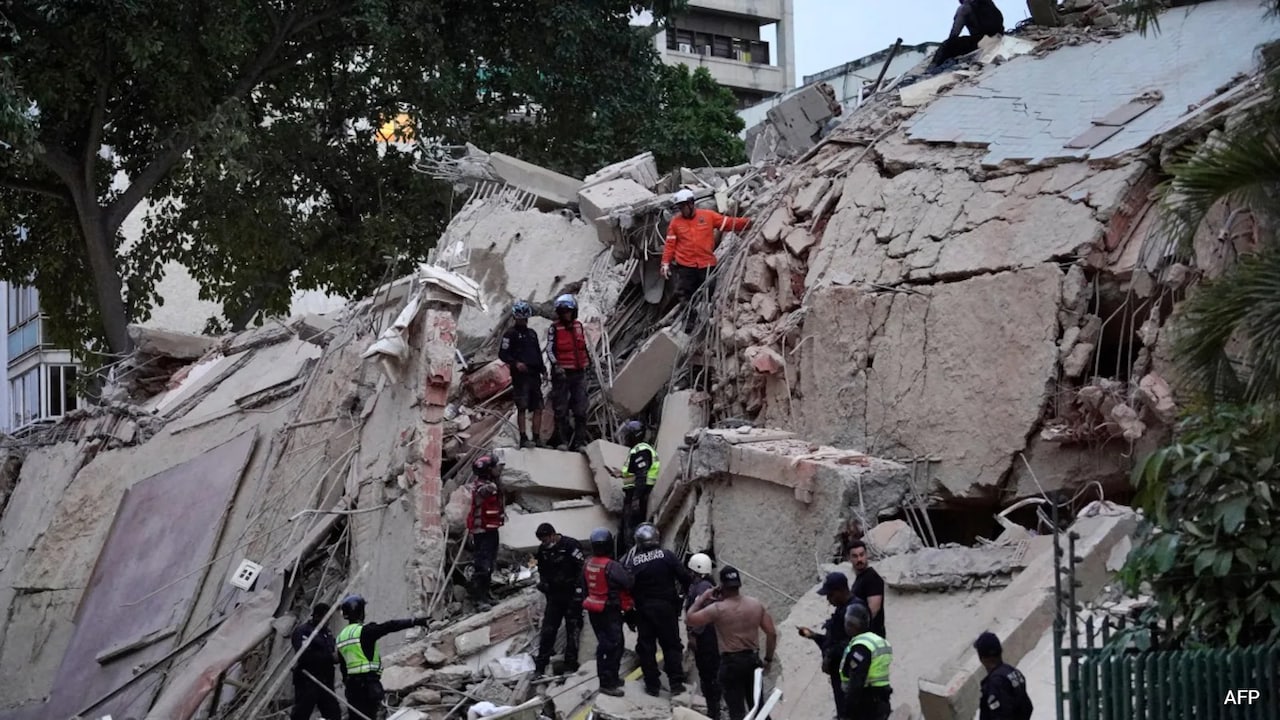
Most people think they understand how earthquakes work. You get a massive shock, the ground rolls like an angry ocean, and then the earth gradually calms down through a series of smaller aftershocks. It's a terrifying experience, but it follows a predictable structural pattern that emergency teams and infrastructure are designed to expect.
Then something like the disaster in Venezuela happens and completely upends our understanding of seismic risk.
On a seemingly quiet evening, a massive magnitude 7.2 earthquake tore across the northern coast of Venezuela, centered near Morón and rattling the capital city of Caracas. Modern buildings shuddered, brick walls cracked, and people panicked, rushing into the streets. But just as they thought the worst was over, a mere 39 seconds later, an even more violent magnitude 7.5 earthquake struck.
This wasn't an aftershock. It was an entirely separate, massive rupture releasing three times more energy than the first.
Seismologists call this rare, devastating phenomenon an earthquake doublet. It's a deadly one-two punch that leaves communities absolutely no time to breathe, let alone evacuate. When two massive earthquakes of nearly identical size hit the exact same region within seconds or hours of each other, standard disaster response strategies fail. The tragedy in Venezuela, which claimed more than 180 lives and injured over 1,500 people, is a stark warning that our global seismic risk models are ignoring a fundamental threat.
Defining the Doublet
To understand why this happens, you have to look at the mechanics of structural failure under the earth. In a standard earthquake scenario, a single fault line accumulates tectonic stress over decades or centuries. Eventually, the rock reaches its breaking point. It slips, releases that pent-up energy as a mainshock, and the local stress drops significantly. The subsequent aftershocks are just smaller adjustments as the surrounding crust settles into its new position.
Doublets break this rule.
An earthquake doublet occurs when a major rupture doesn't relieve stress across the region, but instead instantly transfers that pressure onto an adjacent fault segment or a connected fracture system that is already primed to blow. Think of it like a brittle plastic ruler under extreme tension. If you snap one section, the sudden shift in force can instantly shatter the piece right next to it.
In Venezuela's case, the earthquakes occurred along the complex boundary where the Caribbean tectonic plate slides eastward relative to the South American plate. This boundary isn't a single clean line. It's a complicated web of fractures, including the Boconó fault, the San Sebastián fault, the El Pilar fault, and the Morón fault zone.
These plates grind past one another at roughly two centimeters (0.79 inches) per year. That might sound slow, but on a planetary scale, it's a massive amount of moving mass. It accumulates immense friction. When the first 7.2 quake tore open a shallow strike-slip fault, the rapid horizontal displacement didn't calm the earth. Instead, the seismic waves and physical movement slammed into a neighboring fault segment, pushing it past its structural threshold and triggering the 7.5 rupture 39 seconds later.
Why Twin Earthquakes Bust Open Building Codes
The sheer physics of a doublet means that structural damage isn't just doubled—it scales exponentially. Buildings are engineered to withstand a specific duration and intensity of shaking. When an earthquake hits, a structure experiences peak ground acceleration, causing materials like concrete and steel to flex, deform, and micro-fracture.
If a building survives the first shock, it is often left in a highly compromised, fragile state. Under normal conditions, engineers have days or weeks to inspect these structures, evacuate occupants, and shore up foundations before any significant aftershocks hit.
With a doublet, that window drops to zero.
The structures in Caracas and La Guaira that managed to stand through the 7.2 magnitude shock were instantly subjected to an even stronger 7.5 magnitude pounding while their structural elements were already cracked and weakened. It's the engineering equivalent of taking a heavy blow to the jaw, and then getting hit with a sledgehammer before you can even begin to fall.
Civil engineers point out that a huge portion of the devastation in Venezuela stems from the widespread use of non-ductile, brittle concrete and unreinforced masonry. Ductility is a building's ability to bend and absorb energy without completely breaking. Brittle structures tolerate very little movement before catastrophic failure. Many of the older apartments and informal housing structures across northern Venezuela were built long before modern 1982 seismic codes were implemented. They simply disintegrated under the sustained, back-to-back violent motions.
Fault Interactions and the Failure of Traditional Forecasting
For decades, the standard approach to seismic hazard assessment has relied on a dangerous assumption: that earthquakes happen on one isolated fault at a time. Paleoseismologists have warned that this simplistic model ignores reality. The earth's crust is highly interconnected.
When a fault ruptures, it changes the stress fields for miles around. This process, known as Coulomb stress transfer, can either push neighboring faults closer to failure or delay their next rupture. In a doublet sequence, this transfer happens almost instantly.
Geophysicists studying the USGS data noted that the Venezuelan quakes likely involved two distinct but closely interacting faults. This multifault scenario is a nightmare for risk modeling because it implies that a single hazard zone can generate consecutive massive shocks that multiply the destruction area.
This isn't just a Venezuelan problem. Complex, interconnected fault networks exist all over the globe:
- The San Andreas and San Jacinto fault systems in California.
- The North Anatolian fault zone in Turkey, which experienced a devastating multi-shock sequence in recent years.
- The alpine fault networks running through Japan, Sumatra, and New Zealand.
If our risk models continue to treat these faults as independent entities, we will keep getting caught completely off guard.
The Reality of Public Safety Without Warning Systems
The structural danger is bad enough, but the human toll is worsened by a complete lack of early warning technology. Countries like Japan, Mexico, and parts of the United States rely on dense networks of seismic sensors that detect the initial, non-damaging P-waves of an earthquake. These systems can blast automated alerts to smartphones and trigger automated shutdowns of gas lines and trains seconds before the destructive S-waves arrive.
Venezuela possesses no such early warning infrastructure. When the ground started shaking at 6:04 p.m. local time, residents had absolutely zero advance notice.
The psychological and physical toll of the 39-second gap cannot be overstated. Survivors described fleeing their homes during the first tremor, only to be trapped in stairwells, elevators, or narrow alleys when the second, more powerful shock hit. When thousands of people are simultaneously trying to evacuate compromised structures into streets filled with falling debris, a second earthquake turns an orderly evacuation into a deadly trap.
Emergency resources are instantly overwhelmed. Search and rescue teams cannot safely enter collapsed buildings to look for survivors from the first quake because the ground is still actively rupturing and unstable. Hospitals, already strained by local economic challenges, find themselves flooded with thousands of severe trauma cases simultaneously while their own facilities are structurally suspect.
What Must Change Moving Forward
We can't stop tectonic plates from moving, and we can't predict exactly when a fault will snap. But we can stop pretending that doublet earthquakes are anomalies that don't deserve our attention. They are a predictable feature of complex plate boundaries.
To mitigate this threat globally, seismic strategies must adapt immediately.
First, engineering teams must rewrite building codes to account for cumulative seismic fatigue. Designing a structure to survive a single design-basis earthquake is no longer sufficient if that structure is sitting next to a multi-fault network capable of a doublet. Buildings must be simulated against consecutive, multi-phase shocks to ensure that their primary load-bearing elements don't suffer progressive collapse during rapid-fire events.
Second, urban centers built over strike-slip fault zones must prioritize retrofitting programs for older, brittle concrete and unreinforced masonry buildings. This is an incredibly expensive and difficult task, but leaving these structural time bombs intact guarantees mass casualties when the next doublet hits.
Finally, international geological agencies and local governments must expand seismic sensor arrays to implement functional early warning networks, even in economically vulnerable regions. Giving people even ten seconds of warning can mean the difference between getting crushed inside a brittle stairwell and reaching the relative safety of an open street.
The tragedy along Venezuela's northern coast shouldn't be filed away as a bizarre scientific curiosity. It's a clear, violent demonstration of how the earth actually behaves. If we don't adjust our engineering, our forecasting, and our emergency planning to account for the reality of twin earthquakes, we are simply waiting for the next doublet to level another city. Maintain emergency readiness kits, demand updated local seismic mapping, and advocate for structural retrofits in your local communities before the ground begins to move.