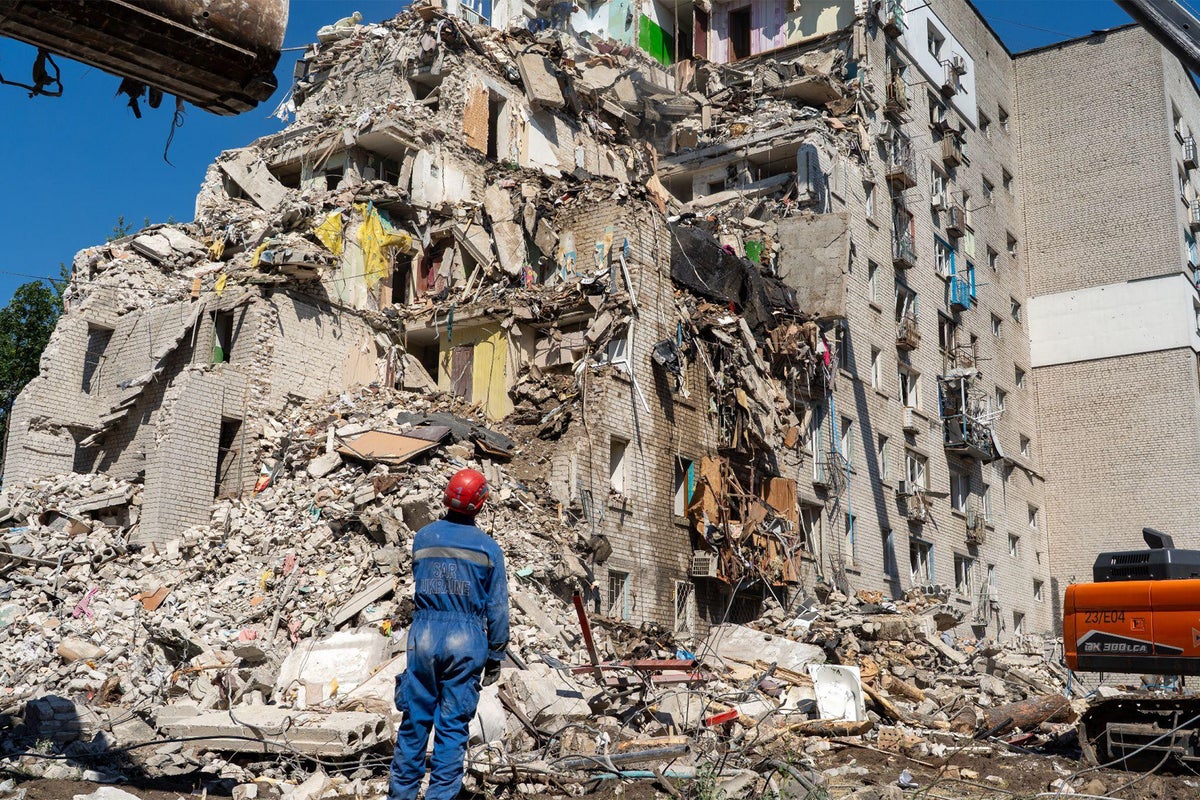
The air raid sirens started singing their wretched song before midnight, but nobody in the capital expected what came next. It wasn't just another routine wave of slow-moving suicide drones meant to drain local air defense stocks. This was a deliberate, coordinated effort to overwhelm the city. By the time the sun crawled over the horizon on Thursday, July 2, 2026, parts of Kyiv were unrecognizable. Plumes of black smoke choked the skyline. The air smelled of burnt concrete, iron, and cordite.
Russia poured hundreds of drones and dozens of advanced missiles into the heart of Ukraine. It became the deadliest single assault on the capital this year. At least 27 people are dead. Another 91 are wounded. Emergency crews are still digging through the shattered teeth of concrete blocks looking for eight missing residents. In similar news, take a look at: Why The Vietnam Boat Tragedy Must Change How We Travel.
If you've been watching this war from a distance, it's easy to get numb to the headlines. You see a number, you shake your head, and you move on with your day. But on the ground, this represents a terrifying shift in tactics and a severe failure of international policy. The strategy of drip-feeding defensive weapons to Ukraine has reached its logical, tragic dead end.
A Night of Fire and Failure in the Capital
The scale of this attack had little precedent. According to statements from Tymur Tkachenko, the head of the Kyiv City Military Administration, the damage spans across three dozen locations. Around 130 buildings across the city suffered significant damage. This wasn't confined to a single frontline zone. It hit the entire breadth of a metropolitan area that roughly three million people call home. Reuters has also covered this critical subject in great detail.
Kyiv Mayor Vitali Klitschko quickly announced a formal day of mourning for the city. He spent his morning walking through the wreckage on the city's left bank of the Dnipro River. That's where a nine-story residential building took a direct hit. The explosion sliced the structure clean in half, exposing the private interiors of family apartments like a horrific dollhouse.
Rescuers recovered five bodies from that single eastern suburb location. Among the injured across the city were paramedics and drivers stationed at a local ambulance depot. They were hit while trying to deploy to help others. Even diplomatic quarters weren't spared. Katarina Mathernova, the European Union ambassador to Ukraine, confirmed that the assault hit accommodation used by diplomatic personnel. While the diplomats themselves escaped physical harm, their living quarters and belongings were consumed by the resulting fires.
This wasn't an accidental drift of a poorly guided weapon. The choice of targets and the timing show a deliberate calculation to inflict maximum civilian casualties and break the psychological spirit of the population.
Breaking Down the Numbers Behind the Assault
The sheer volume of ordnance used in this single overnight operation should alarm military strategists worldwide. The Ukrainian air force confirmed that Russian forces launched 74 missiles alongside an astounding 496 attack drones.
Air Force spokesperson Yuri Ihnat pointed out a disturbing detail about the composition of the raid. The Kremlin deployed an unusually high number of ballistic missiles. These weapons travel at incredible speeds and follow a steep trajectory, leaving local defense crews with only a few minutes of warning. The interception rate for these ballistic variants was noticeably low compared to the standard cruise missiles that Ukrainian systems usually swat out of the sky.
Moscow didn't deny the operation. Instead, the Russian Defense Ministry used its official channels to boast about what it called a massive attack using long-range, high-precision air, land, and sea-launched weapons. They claimed the strikes strictly targeted military sites, energy facilities, and airports. Anyone standing on the left bank of the Dnipro looking at the ruins of a nine-story apartment building knows that claim is an outright lie.
The Kremlin framed the slaughter as a retaliatory action. In the weeks leading up to this event, Ukraine had successfully targeted Russia's internal fuel supply chain. Just hours before the Kyiv bombardment, a Ukrainian drone strike successfully hit an oil refinery deep inside the Russian region of Nizhny Novgorod, killing one person at an industrial facility. Russia's response was to level civilian neighborhoods in the Ukrainian capital.
The High Price of Delayed Western Pledges
President Volodymyr Zelenskyy had to cut short an official diplomatic visit to Ireland to fly back to a capital in mourning. Standing near the ruined residential block, his frustration was completely transparent. He didn't offer the usual diplomatic platitudes. He placed the blame exactly where it belonged.
Zelenskyy stated clearly that the destruction was a direct result of a failure by Western allies to deliver promised air defense systems on time. He noted that if partners had simply delivered on their explicit promises when they said they would, many of these homes and lives would have been saved. He argued that Ukraine isn't even asking for extra equipment at this stage, just the fulfillment of existing agreements.
The math here is brutal. When air defense systems run low on interceptor missiles, commanders have to make impossible choices. Do they protect a thermal power plant, a military staging area, or a residential suburb? When 496 drones are flooding the radar screens alongside dozens of ballistic missiles, the defense grid simply runs out of arrows.
Western nations frequently issue press releases celebrating multi-billion-dollar aid packages. But a package announced in a Washington or Brussels briefing room doesn't stop a ballistic missile over Kyiv. The bureaucratic delays in manufacturing, shipping, and clearing these weapon systems are measured in human lives.
How Kyiv Citizens Respond to the Terror
If Moscow expected this overwhelming show of force to break the will of the local population, they haven't been paying attention to the last few years. The dominant mood in the capital isn't panic. It's a mix of deep sorrow and intense, icy anger.
Volunteers didn't wait for official instructions. Hundreds of residents showed up at the strike sites with shovels, crowbars, and their bare hands. They formed human chains to clear heavy masonry, passing chunks of concrete from man to man to help emergency crews search for the missing. Local cafes handed out free coffee to exhausted rescue workers who had been digging through the dust without a break since 3 a.m.
This resilience is remarkable, but we shouldn't romanticize it. It's a coping mechanism born out of absolute necessity. The people of Kyiv clean up the glass, board up the windows, and go back to work because the alternative is giving up their existence. UN Secretary-General Antonio Guterres condemned the strikes, calling them part of a deadly pattern targeting populated areas. But verbal condemnations don't rebuild a collapsed nine-story building, nor do they bring back the dead.
Concrete Steps the International Community Must Take Now
The current strategy of managing the escalation of this conflict isn't working. It's costing dozens of civilian lives in single-night actions. To prevent the complete exhaustion of Ukraine's urban defense grids, international partners need to pivot immediately to several actionable steps.
First, air defense logistics must bypass standard peacetime bureaucratic channels. Systems like Patriot, IRIS-T, and NASAMS that are sitting in Western warehouses or active European sectors need to be transferred to Ukrainian custody immediately. The delivery timelines must be compressed from months to days.
Second, the restrictions on striking military targets deep within Russian territory must be entirely dismantled. Ukraine cannot win a defensive war by simply trying to intercept an infinite supply of cheap drones and missiles at the point of impact. They must be allowed to strike the airfields, bombers, and launch platforms inside Russia before the weapons ever leave the ground.
Finally, global tracking and blocking of Western-made microchips found inside Russian missiles must be tightened. Investigations of wreckage from recent strikes continually reveal components manufactured by companies based in allied nations. These parts filter through third-party supply routes in Central Asia and East Asia. Sanctions must target these intermediary shell companies with zero leniency.
The rubble in Kyiv is still hot. The search for the eight missing residents continues under the glare of emergency floodlights. The international community needs to decide whether its promises to Ukraine are genuine commitments or just empty political rhetoric.