The ground didn't just shake once. It shook twice, less than 40 seconds apart, shattering the northern coast of Venezuela. On June 24, 2026, a magnitude 7.2 seismic shock caught the coastal state of La Guaira completely off guard. Before anyone could process the initial terror, a massive 7.5 magnitude mainshock followed.
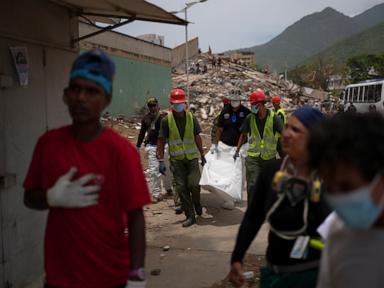
Now, the official death toll stands at 2,295, but that number rises every hour. Thousands more remain missing beneath concrete slabs. The true emergency isn't just digging out survivors anymore; it's managing a massive logistical breakdown of human remains.
If you think your local disaster response plan can handle this kind of back-to-back catastrophe, you're dead wrong. The sheer scale of what happens when infrastructure collapses twice in one minute is currently overwhelming every system in Venezuela, from hospital morgues to basic burial logistics.
The Real Crisis Behind the Deadlock in La Guaira
People are searching the internet to understand how a modern disaster recovery effort can stall so quickly. The answer is simple. The local infrastructure was obliterated, and the immediate influx of casualties instantly broke the medical and forensic chain of custody.
When emergency crews or desperate civilians pull a body from the rubble in Catia La Mar or central La Guaira, there's nowhere for that body to go. Hospitals turned emergency vehicles away on day one because their cooling facilities were full or lacked power. Dozens of bodies ended up lying in open parking lots under a blistering tropical sun. At one point, over 200 bodies sat on the asphalt of a government-run health facility.
The immediate issue facing families isn't just grief. It's an agonizing race against time and decay.
Forensic technician Joel Mirabal has spent over a week straight driving through ruined neighborhoods. He publicly estimated that in up to 70% of recoveries, a relative or neighbor is nearby to make an immediate identification. But for the remaining 30%, the process stalls completely. Severe crush trauma from layers of heavy debris alters human features beyond recognition. Mirabal noted that many victims don't look even 10% like they did in real life, forcing families to rely entirely on scars, distinct tattoos, or a specific pair of shoes.
When Identification Happens, the Financial Wall Hits
Identifying a loved one doesn't end the nightmare. In fact, for many Venezuelans, it triggers a second, deeply cruel bureaucratic and economic hurdle.
Take the case of Rosa López. Her 25-year-old son-in-law, José Antonio Toledo, was killed while working as a security guard when his building pancaked. After tracking his body from an overfilled hospital to a sweltering open parking lot, the family faced a sudden financial barrier. Local funeral homes started demanding around $450 to handle a body. In an economy already stretched to its absolute limit, that is an impossible fortune for an average worker.
Without that cash, families face the terrifying prospect of their relatives being moved to mass graves. López managed to bypass this fate only because the local mayor's office stepped in at midnight to offer a free plot in a hillside cemetery, forcing her and her daughter to hike up a dark trail to bury Toledo themselves an hour later.
For those who can't find a spot or can't afford a private service, the bodies are transferred to a makeshift mega-morgue established at the La Guaira seaport. Private shipping companies have stepped in to donate large, refrigerated shipping containers to help preserve the remains. Still, everyone on the ground admits this is a temporary band-aid.
Why Twin Earthquakes Break Traditional Forensic Systems
Traditional disaster response relies on a predictable sequence. The earthquake stops, rescue teams deploy, hospitals stabilize the living, and morgues process the deceased. A "doublet" earthquake throws that playbook out the window.
- Compounded Structural Damage: Buildings weakened by the 7.2 quake completely collapsed during the 7.5 mainshock, burying victims under deeper, more compacted layers of concrete.
- Total Infrastructure Blackout: Water lines, electricity, and communication networks failed instantly across La Guaira and Caracas, meaning forensic teams lost the refrigeration and data access required for systematic DNA and fingerprint cataloging.
- The Threat of Mass Graves: Forensic specialists openly admit that mass graves will become inevitable. When processing capacity is outnumbered by incoming remains by a factor of ten, public health concerns regarding decomposition take precedence over individual identification timelines.
The Next Critical Steps for Regional Emergency Response
What is happening in Venezuela serves as a stark warning for other seismically active zones globally. Relying on centralized municipal morgues during a major regional disaster is a fatal flaw.
If international aid groups and local authorities want to prevent total chaotic collapse during the next inevitable doublet event, they must pivot to decentralized, mobile forensic setups immediately. This means pre-positioning refrigerated storage units outside major fault lines and training local community leaders on basic, dignified temporary preservation methods.
Right now, the priority in La Guaira remains fixed on the seaport morgue. Families continue to wait outside the gates in long lines alongside funeral vans, hoping for a chance to view personal effects before the option of an individual burial vanishes completely. If you are looking to support the ongoing recovery efforts or track missing persons reports verified by international monitors, you can find active field updates directly through the Doctors of the World emergency response network.