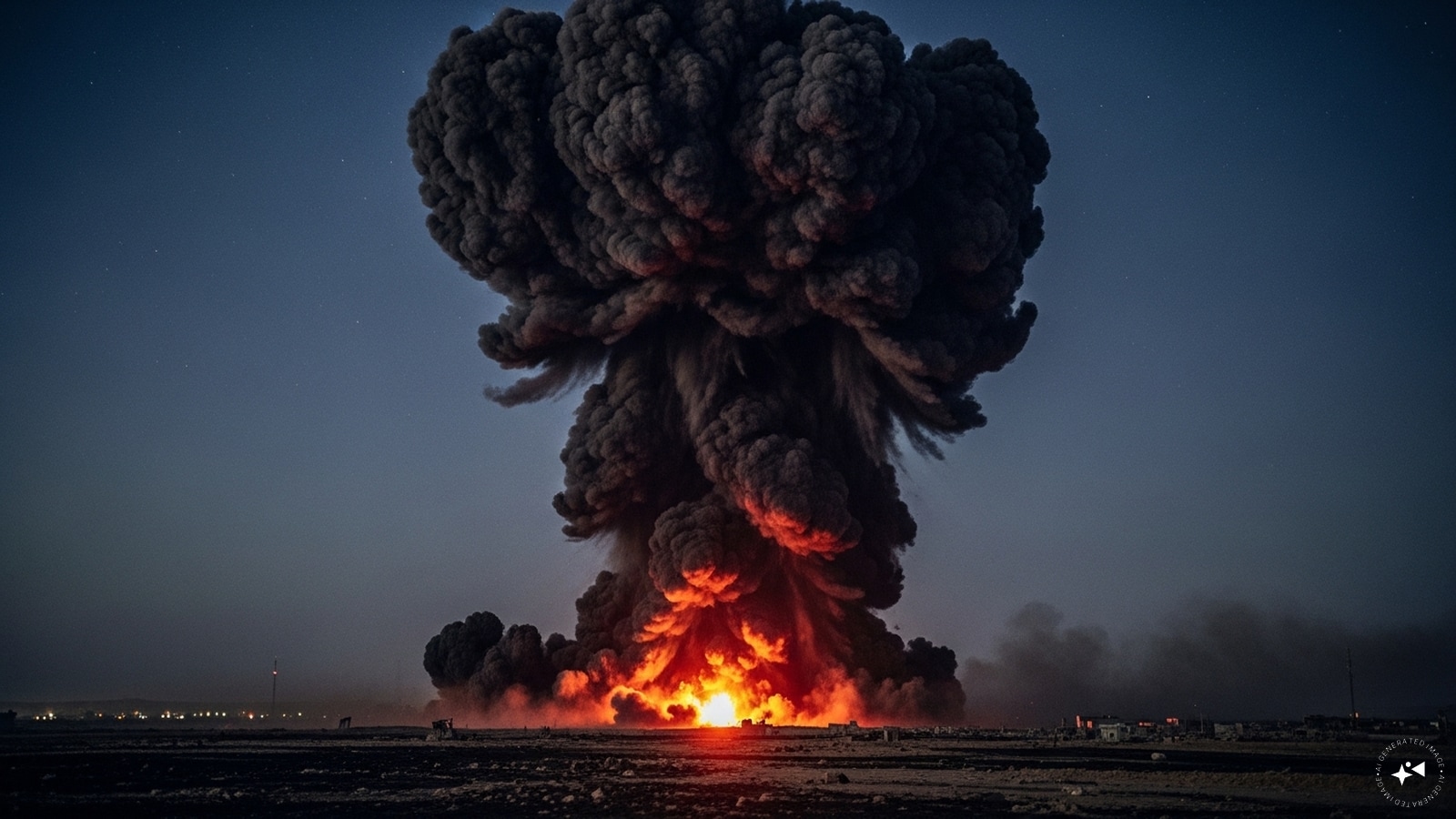
The dust hasn't even settled, but the message is crystal clear.
When US Defense Secretary Pete Hegseth shared a photo on social media showing a maritime surveillance tower crumbling at Iran's Chabahar port, it wasn't just a tactical win in a running military feud. It was a devastating physical blow to a multi-million-dollar dream New Delhi spent two decades building.
The US military recently expanded its aerial campaign, targeting Iranian military infrastructure, coastal monitoring sites, and transit hubs. This time, the crosshairs landed directly on Chabahar's Shahid Kalantari port. While Iran claims the collapsed tower merely supervised civilian cargo traffic, Washington knows better. The Islamic Revolutionary Guard Corps (IRGC) routinely uses these commercial gateways to monitor the Gulf of Oman and pull the strings on regional shipping.
But the real casualty of this collapsing concrete isn't just Iranian pride. It's India’s strategic autonomy.
The Day the Tower Fell
For months, the US and Iran have traded heavy blows, completely shattering their brief, fragile ceasefire. But the targeted strikes on Chabahar port represent a major escalation. US fighter jets, warships, and drones hammered coastal facilities, knocking out the local power grid and leaving half of Chabahar in the dark.
Then came the image.
Shared widely by local activists before Hegseth highlighted it, the photo of the collapsing maritime control tower became an instant symbol of the conflict. Witness footage from the ground showed thick, black smoke rising from the docks. While Iranian state media tried to downplay the strike by focusing on the civilian nature of the port, they couldn't hide the structural devastation. The control tower is gone. The facility's ability to coordinate vessel movement is paralyzed.
For Washington, this is about choking Iran's maritime military capabilities. For India, it’s a ringside seat to the destruction of an Rs 800 crore investment.
Why India Cares So Much About This Strip of Coast
You have to understand the geography to understand the panic in New Delhi.
India has a massive Pakistan problem. Because of hostile borders, India cannot easily send trucks or trains overland to Afghanistan, Central Asia, or Europe. It's completely blocked.
Chabahar was the ultimate end-run around this geopolitical wall. By shipping goods from India’s western ports directly to Chabahar on Iran’s southern coast, Indian traders could bypass Pakistan entirely. From there, a planned railway line would carry cargo north into Afghanistan and onward to resource-rich Central Asian countries.
It was a brilliant plan. It was also incredibly expensive.
India poured Rs 800 crore (roughly $120 million) into the project. Just in 2024, New Delhi signed a historic 10-year agreement with Iran to operate the Shahid Beheshti terminal at the port. The ink was barely dry on the contracts when the geopolitical weather turned freezing cold.
Trump Pulls the Plug
When Donald Trump reclaimed the White House, the clock started ticking for India's Iranian ambitions.
In September 2025, the US State Department revoked a crucial sanctions exception that had protected the Chabahar project since 2018. The message from Washington was blunt: "Wind down, or face our wrath."
India lobbied hard. It managed to secure a brief, conditional waiver extension that lasted until April 26, 2026. But Washington made it clear that there would be no more extensions. Under the heavy hand of Trump’s National Security Presidential Memorandum (NSPM-2), any foreign entity dealing with Iranian ports now faces secondary US sanctions.
This put New Delhi in an impossible position. Do you risk the wrath of the US Treasury, potentially getting your state-run banks blacklisted and your global trade locked down? Or do you walk away from a 23-year-old dream?
Honestly, India chose a secret third option: the corporate shell game.
The Shell Game to Dodge Sanctions
India didn't want to officially abandon the port, but it couldn't afford to get caught in the US sanctions dragnet. So, the government got creative.
Just a day before the US sanctions were set to hit last autumn, the entire board of directors at India Ports Global Limited (IPGL)—the state-backed company managing the port—resigned en masse. IPGL's official website was quietly pulled offline.
Behind closed doors, Indian and Iranian officials worked out a temporary transfer of IPGL's holdings. They shifted operational control to a local Iranian company. The unwritten, informal understanding is simple: India will let Iran run the show for now to keep its hands clean. Once the geopolitical storm blows over and sanctions ease, India plans to step back in and reclaim its stake.
It's a clever trick, but it's incredibly risky. And now, with US bombs literally dropping on the physical infrastructure of the port, the strategy looks increasingly fragile.
The Real Cost of a Broken Dream
With the watchtower gone and the port repeatedly targeted by US jets, the commercial viability of Chabahar is practically dead for the foreseeable future.
No private shipping company is going to risk its multi-million-dollar cargo vessels in a port that is actively being bombed. No international insurance firm will underwrite a ship docking at a facility where the control tower was just reduced to rubble.
While India's Ministry of External Affairs claims it has already fulfilled its financial commitments and bought the necessary equipment, those assets are now sitting in a war zone.
This leaves a massive geopolitical vacuum. If India is forced to step back, who steps in?
The answer is obvious: China. Beijing is already heavily invested in Pakistan's Gwadar port, just 170 kilometers down the coast from Chabahar. If India's presence in Iran completely collapses, it hands a massive regional advantage to its biggest rival.
What Happens Now
If you're looking for a neat, happy ending to this geopolitical mess, you won't find one. The path forward for India is incredibly narrow.
First, New Delhi must double down on parallel trade routes. With Chabahar effectively frozen and under fire, India has to pivot resources toward the International North-South Transport Corridor (INSTC) through other entry points, or strengthen its maritime trade agreements with Arabian Gulf partners.
Second, India's diplomats have to accept a hard truth. You cannot play both sides when the US goes into "maximum pressure" mode. The attempt to maintain a back-door presence in Iran while keeping Washington happy is hitting its physical limit.
The smoking ruins of Chabahar's watchtower prove that in 2026, fence-sitting is no longer an option. You either choose the global financial system dominated by the US, or you choose a highly unstable, heavily bombed gateway to Central Asia. New Delhi has already made its quiet choice. Now, it's time to write off the losses and move on.