Beijing is changing its playbook on India's borders, and it isn't looking north toward the Himalayas this time. Instead, the focus has shifted sharply to the east.
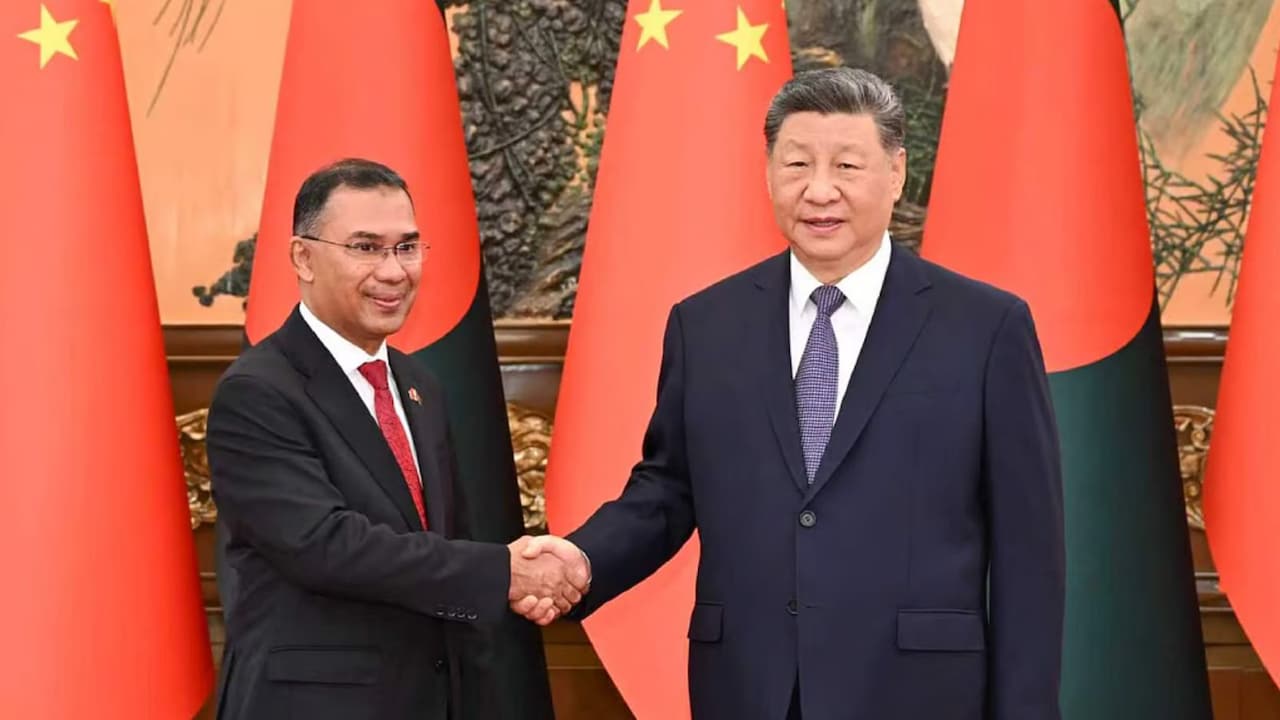
During Bangladeshi Prime Minister Tarique Rahman's recent visit to Beijing, Chinese President Xi Jinping officially endorsed a brand-new transnational infrastructure plan: the China-Myanmar-Bangladesh Economic Corridor.
If you think this sounds like a standard trade deal, you're missing the bigger picture. This is a deliberate, highly strategic move to encircle India from the east, mimicking what the China-Pakistan Economic Corridor (CPEC) did to India's west. After spending billions securing access to the Arabian Sea via Pakistan, Beijing is now aggressively carving out a direct land route to the Bay of Bengal.
The message from Beijing is clear. If India won't join China's connectivity plans, China will simply build around India.
The Death of BCIM and the Birth of a Threat
For years, regional connectivity conversations centered on the Bangladesh-China-India-Myanmar (BCIM) corridor. It was supposed to be a massive multi-modal network connecting Kunming in China to Kolkata in India, passing through Myanmar and Bangladesh.
But India didn't buy it. New Delhi routinely boycotted the Belt and Road Initiative (BRI) because CPEC cuts right through Pakistan-occupied Kashmir, directly violating Indian sovereignty. Because of India's firm stance, the BCIM stalled out and effectively died.
Beijing got tired of waiting. This new proposal completely drops India from the equation. By reviving the old route but cutting Kolkata out entirely, China is attempting to connect Yunnan province directly to the ports of Bangladesh via Myanmar.
This creates a massive security headache for New Delhi. Instead of a cooperative regional trade route, India is now looking at a Chinese-engineered corridor wrapping right around its highly sensitive northeastern states.
Why the Bay of Bengal Matters to Beijing
To understand why China is pushing so hard for this, you have to look at the Malacca Dilemma.
Right now, roughly 80% of China's seaborne energy imports must travel through the narrow Strait of Malacca. In any future conflict—especially over Taiwan—that bottleneck could easily be blocked by the US Navy or its allies, completely choking off China's economy.
[China (Yunnan)] ───► [Myanmar (Civil War Risks)] ───► [Bangladesh (Mongla/Chattogram)] ───► Bay of Bengal
Beijing needs alternative backdoors to the Indian Ocean. The proposed corridor offers exactly that. It links up with existing projects like the deep-sea port at Kyaukpyu in Myanmar's Rakhine State and extends toward Bangladesh's key maritime hubs.
But China isn't just looking for trade routes; it's aggressively buying up strategic real estate. During the same Beijing meetings, Bangladesh agreed to develop a brand-new economic zone right near Mongla Port using a Chinese state-owned firm.
What makes this particularly stinging for New Delhi? That exact patch of land near Mongla Port was originally earmarked for an India-backed development project under a 2015 bilateral agreement. China essentially swooped in and snatched it from right under India's nose.
The Massive Roadblocks Ahead
On paper, this sounds like a geopolitical checkmate. In reality, China's new corridor faces an absolute nightmare on the ground.
The entire project relies on transit through Myanmar, a country currently ripping itself apart in a brutal civil war. The military junta in Naypyidaw is losing ground fast. Vast swaths of the country—including key border areas near China and the crucial Rakhine State where the Kyaukpyu port sits—are no longer under the military's control. They are ruled by powerful ethnic armed organizations like the Arakan Army.
Building multi-billion-dollar railways and highways through an active war zone is an incredibly risky bet. Myanmar even passed a Private Security Services Law to allow Chinese private security firms to legally enter the country to protect BRI infrastructure. But hiding behind mercenaries won't magically solve the stability problem.
Furthermore, Bangladesh is playing a delicate balancing game. While Prime Minister Tarique Rahman's administration wants Chinese cash to modernize Chattogram and Mongla ports, Dhaka knows it cannot afford to completely alienate India, its closest geographic neighbor and a vital trading partner.
What India Must Do Next
New Delhi cannot afford to sit back and watch this corridor materialize. Relying on the hope that Myanmar's civil war will permanently break China's plans is a terrible strategy.
India needs a fast, aggressive counter-play.
- Revive the Kaladan Project Immediately: India’s own Kaladan Multimodal Transit Transport Project and the India-Myanmar-Thailand Trilateral Highway have faced years of bureaucratic delays. New Delhi must fast-track these initiatives to secure its own economic footprint in Myanmar.
- Engage with Myanmar's Real Power Brokers: India has traditionally dealt only with the official military junta. It's time for a pragmatic shift. New Delhi must quietly deepen its communication lines with the ethnic armed groups holding the actual territory along the transport routes.
- Double Down on Bangladesh: India needs to offer Dhaka better economic alternatives. If China is offering port modernization, India must match or exceed those terms with faster execution and fewer strings attached.
- Fortify the Andaman and Nicobar Command: Militarily, India must continue turning the Andaman and Nicobar Islands into an impenetrable maritime fortress to maintain absolute dominance over the Bay of Bengal entry points.
The geopolitical landscape on India's eastern flank is shifting faster than ever. If New Delhi doesn't step up its execution speed, it'll wake up to find itself completely boxed in by Chinese concrete.