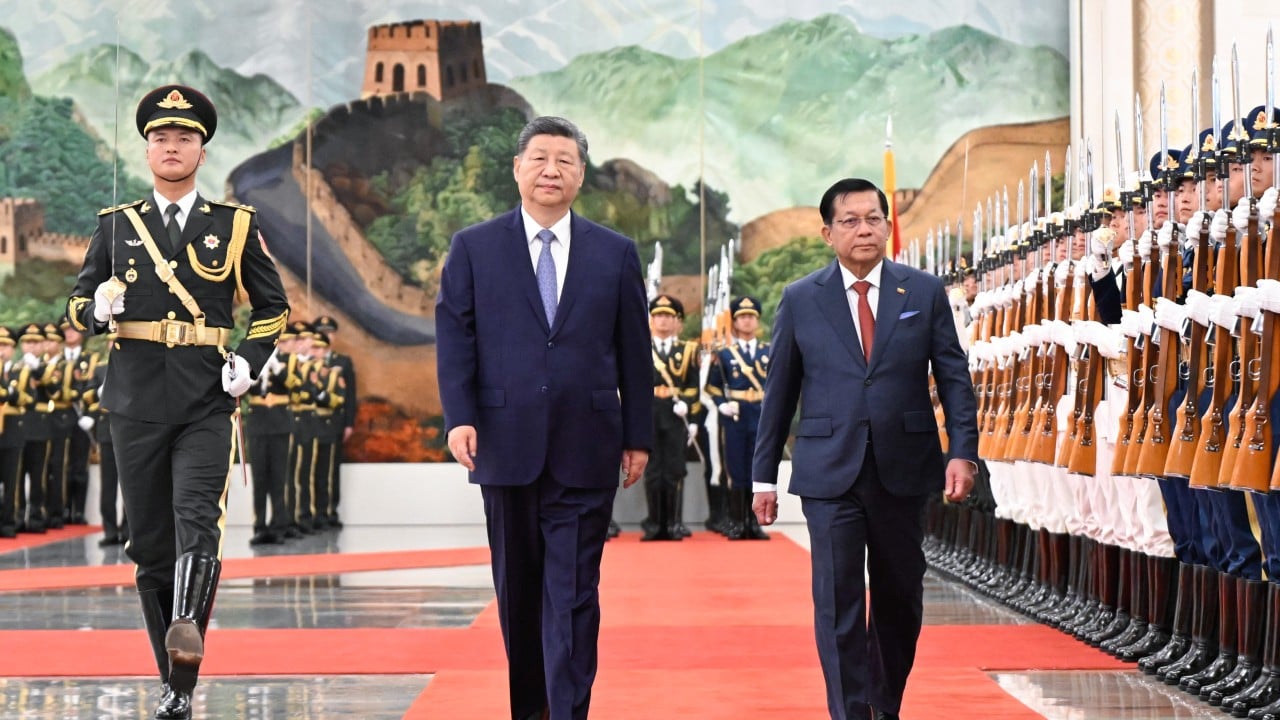
Whenever Myanmar's military leaders land in New Delhi, the regional commentariat treats it like a seismic shift. Analysts start talking about a bold new balancing act, suggesting the junta is finally ready to throw off Beijing's heavy yoke. We saw this playbook again recently during U Min Aung Hlaing's high-profile visit to India, where Prime Minister Narendra Modi rolled out the red carpet at Hyderabad House.
But if you think these closer ties are keeping Xi Jinping up at night, you're looking at the chessboard completely wrong. You might also find this connected story useful: Why King Charles Is Evicting Himself From Buckingham Palace.
The reality is far less dramatic. Beijing isn't sweating over New Delhi's overtures to Naypyidaw because it doesn't have to. For all of India’s strategic ambitions, its relationship with Myanmar operates in a totally different league than China's deep structural dominance. Myanmar's pivot to India isn't an existential threat to Chinese influence. It's just a desperate regime shopping for a bit of diplomatic breathing room.
The Massive Scale Gap India Cant Close
Let's look at the hard numbers. You can't understand this dynamic without realizing just how lopsided the economic realities are. As highlighted in recent reports by The Guardian, the implications are widespread.
Chinese investment in Myanmar sits at nearly $22 billion. That covers everything from massive energy grids and mining operations to deep-water ports. Over the past year alone, bilateral trade between China and Myanmar jumped by 19 percent, while Chinese investment surged by a staggering 230 percent.
India's economic footprint doesn't even come close to this. New Delhi’s flagship initiatives, like the Kaladan Multi-Modal Transit Transport Project and the India-Myanmar-Thailand Trilateral Highway, have been plagued by endless bureaucratic delays and worsening security conditions in Chin State and Sagaing Region. India pitches these projects as tools for regional integration, but they simply lack the raw financial muscle and fast-track execution that Beijing brings to the table.
+--------------------------------------------------------------+
|                    THE POWER IMBALANCE                       |
+--------------------------------------------------------------+
|  CHINA:                                                      |
|  - $22 Billion in total investment                           |
|  - 230% Investment surge over the past year                  |
|  - Direct, state-backed energy and trade pipelines           |
|                                                              |
|  INDIA:                                                      |
|  - Stalled infrastructure (Kaladan & Trilateral Highway)     |
|  - Security-focused, cross-border stability goals            |
|  - Limited commercial leverage compared to Beijing           |
+--------------------------------------------------------------+
The Indian Ocean Pipeline China Wont Give Up
Beijing's relationship with Myanmar isn't built on warm, fuzzy feelings. It's built on a brutal geographic necessity. The crown jewel of their partnership is the China-Myanmar Economic Corridor (CMEC). This massive Belt and Road Initiative network links China’s landlocked Yunnan province straight to the deep-water port of Kyaukpyu on the Bay of Bengal.
Think about why this matters so much to Beijing. Right now, roughly 80 percent of China’s seaborne energy imports have to squeeze through the narrow Malacca Strait. If a conflict breaks out, that bottleneck is a massive vulnerability. The CMEC gives China a direct backdoor to the Indian Ocean, bypassing that chokepoint completely.
India's engagement with Myanmar is driven by defensive anxieties. New Delhi wants to protect its volatile northeastern frontier, crack down on cross-border insurgent groups, and prevent the spillover of drugs and weapons. China, on the other hand, is playing an offensive, global game. They are securing an alternative trade artery for the world's second-largest economy. India wants border management; China wants a continental bridge.
The Flaw In Indias Relations Without Domination Pitch
New Delhi likes to position itself as a kinder, gentler neighbor. Indian diplomats quietly pitch a relationship without domination, assuring the military leadership that India respects their sovereignty and won't meddle in their internal political chaos. It's a clever marketing line.
But honestly, the junta knows that India’s hands are tied. India has to tread carefully because it faces constant scrutiny from its own democratic institutions and international partners. New Delhi cannot offer the total, uncritical diplomatic cover that a veto-wielding superpower like China provides on the global stage.
We saw this exact dynamic play out in real time. Right after wrapping up talks in New Delhi, Myanmar’s foreign minister rushed to Beijing to brief Wang Yi. Just days later, U Min Aung Hlaing flew to China for an official state visit, complete with a 21-gun salute at the Great Hall of the People and the signing of 18 new memoranda of understanding. The message was unmistakable: Myanmar might flirt with India for legitimacy, but it still runs home to Beijing when it needs real protection.
The Junta's Eternal Balancing Act
Myanmar has spent decades trying to avoid becoming a total vassal state of China. The military rulers are fiercely nationalistic and deeply paranoid about foreign influence. They use India precisely for this reason—as a diplomatic counterweight to keep Beijing from getting too heavy-handed.
But using India as a buffer is very different from replacing China. The regime simply cannot survive without Chinese arms, technology, and economic lifelines. Beijing also holds massive leverage along the shared border, maintaining deep ties with several powerful Ethnic Armed Organizations (EAOs). If Naypyidaw leans too far toward India, Beijing can easily tweak its border policy or adjust its tacit support for rebel factions to bring the junta right back into line.
What This Means For Regional Strategy
If you're tracking the geopolitics of the Bay of Bengal, stop waiting for Myanmar to make a dramatic break from China. It's not going to happen. Instead, watch how these two powers manage their overlapping interests in the region.
Your next steps for analyzing this space effectively:
- Track the progress at Kyaukpyu: Watch the actual construction milestones of the deep-sea port and the Muse-Mandalay railway. This is the real metric of Chinese influence, not diplomatic communiqués.
- Monitor India’s border infrastructure: Keep an eye on whether India can actually secure the Kaladan corridor amid the ongoing civil war. If New Delhi can't finish its own projects, its leverage will continue to shrink.
- Look at the EAO dynamics: Watch how Beijing manages the rebel groups along its northern border. This remains the ultimate lever of control over the central government in Naypyidaw.