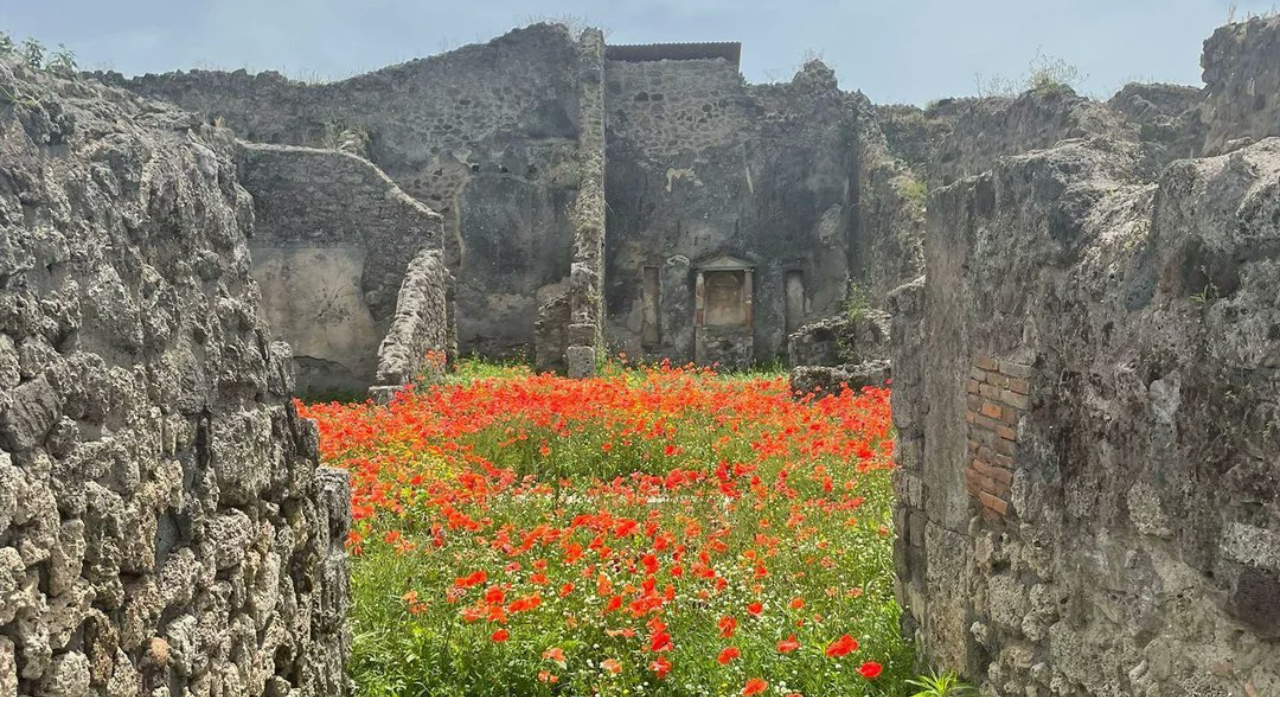
Walk down the dark basalt paving stones of the Via dell’Abbondanza in the spring, and you will see something that feels like an impossible contradiction. Bright red poppies are bursting through the cracks of a road frozen in time. Two thousand years ago, this very street was buried under tons of lethal volcanic ash and pumice. Today, the heavy ruts carved by Roman wagon wheels are filled with wild Mediterranean flora.
Most people look at Pompeii as a giant, tragic outdoor museum. They see the plaster casts of victims, the roofless stone villas, and the shadow of Mount Vesuvius looming over the horizon. They view it as a place of absolute death. But if you visit during the right months, you quickly realize that nature has spent two millennia turning this disaster zone into a vibrant, living ecosystem. Expanding on this theme, you can find more in: Why That Terrifying Ryanair Cabin Window Decompression Explains Your Absolute Need For A Seatbelt.
This isn't just a lucky break for travel photographers looking for a dramatic contrast. The fact that Pompeii ancient streets are blooming with flowers represents a massive shift in how we understand, manage, and experience ancient history. It turns out that the very catastrophe that erased Roman life created the perfect environment for a biological resurrection.
The Radical Chemistry Behind the Blooms
You can't talk about the flowers of Pompeii without talking about the soil. When Vesuvius blew its top in AD 79, it didn't just destroy life; it redistributed wealth in the form of raw minerals. The volcanic ash and pumice that suffocated the city were packed with potassium, phosphorus, and sulfur. Experts at The Points Guy have also weighed in on this situation.
Over centuries, that thick layer of debris broke down into some of the most fertile ground on the planet.
When early archaeologists stripped away the ash to expose the stone streets, they left behind thin pockets of this mineral-rich dirt between the cobblestones. Combine that hyper-charged soil with the intense southern Italian sun and heavy winter rains, and you get a botanical engine that refuses to quit. The red poppies, known scientifically as Papaver rhoeas, are opportunistic. They love disturbed, rocky ground. They thrive in the spaces where human infrastructure cracks open.
Seeing these red petals flutter against the dark, volcanic basalt is mesmerizing. The Romans built these roads to last forever, using heavy volcanic stone that absorbed the heat of the day. Now, that same heat warms the roots of the plants, forcing early spring blooms before the rest of the countryside catches up.
The Secret Glowing Infrastructure of the Roman Road
If you look closely at the paving stones where the poppies grow, you will notice another detail that most casual tourists walk right past. Interspersed among the dark basalt stones are tiny, glittering fragments of white marble and travertine.
This wasn't an accident. Roman engineers put them there on purpose.
Because Roman cities didn't have streetlights, navigating after dark was notoriously dangerous. The local government even passed laws forcing heavy freight traffic to move through the streets primarily at night to avoid daytime gridlock. To prevent pedestrians from getting run over by a speeding wagon or stepping into open drainage channels, engineers embedded these reflective white stones to catch the moonlight. They were the ancient world's version of cat's-eye road reflectors.
Now, the wildflowers grow in the exact gaps surrounding these reflective markers. It creates a surreal visual rhythm. You have the dark volcanic rock, the white flashes of ancient engineering, and the brilliant crimson of the poppies all competing for space. It is a tangible reminder that Roman urban planners were deeply focused on the daily mechanics of living, oblivious to the fact that their engineering would eventually become a planter box for wild nature.
Moving Past the Cult of Ruins
For a long time, the management at the Pompeii Archaeological Park treated plant life as the enemy. If you talk to traditional conservators, they will tell you horror stories about ivy roots splitting ancient brickwork or wild fig trees tearing down fragile frescoes. For decades, the goal was to kill every green thing that dared to sprout inside the archaeological zone. The site had to be sterile, clean, and dead.
Gabriel Zuchtriegel, the current director of the park, turned that philosophy completely on its head.
He has openly stated that the greenery of Pompeii, once perceived as a threat to preservation, is actually an indispensable part of the historical experience. The natural environment and the archaeological remains belong together. They shouldn't be separated by chemical weed killers.
By allowing the native Mediterranean vegetation to reclaim certain areas under careful supervision, the park is actively reducing its reliance on harsh interventions. It keeps the microclimate cooler, stabilizes the soil, and gives visitors a much more accurate sense of what the region actually felt like before the concrete and asphalt of the modern world took over.
Recreating the Ancient Perfume Trade at the Garden of Hercules
The natural blooming of wildflowers along the streets is only half the story. The park has gone a step further by launching massive archaeobotanical restoration projects to replant the actual gardens the Romans cultivated.
The most exciting example of this is the recent reopening of the Garden of Hercules, also known as the House of the Perfumer.
This wasn't just a wealthy person's backyard. It was a fully functioning commercial enterprise dedicated to making high-end perfumes and essential oils. During the Roman era, the Campania region was famous across the Mediterranean for its luxury scents.
To bring this specific house back to life, teams of botanists, geneticists, and archaeologists spent years analyzing the soil. They didn't just guess what plants to put there. They used deep-core soil samples to isolate ancient pollens, charcoal fragments, and root casts left behind in the ash.
The result is a stunning, working replica of a Roman perfume garden filled with over 3,000 carefully selected plants:
- 800 ancient rose bushes, specifically the double-flowered red rose that blooms twice a year and was prized by Roman elites.
- 1,200 violets, used both for their deep scent and to color luxury garments.
- 1,000 ruscus plants, dense evergreen shrubs used for ornamental hedging.
- Dozens of fruit trees, including quince and cherry, alongside rows of commercial grapevines.
Walking into this specific domus isn't just a visual experience. The air smells thick with the heavy, sweet scent of roses and aromatic herbs, matching the exact sensory environment a Roman citizen would have experienced while buying their morning cosmetics.
The Botanical Detective Work Saving the Site
This green movement rests heavily on the shoulders of historical detective work. Back in the 1950s, an American botanist named Wilhelmina Jashemski did something revolutionary. While most archaeologists were hunting for gold, statues, and grand inscriptions, she started pouring plaster into the hollow cavities found in the garden dirt.
Those cavities were left behind by the decomposed roots of ancient plants.
By analyzing those root casts and combining the data with microscopic pollen analysis, Jashemski proved that the Romans were obsessed with integrating agriculture directly into their urban environments. Their homes weren't isolated from the land. They had small market gardens, vineyards, and orchards tucked right behind their dining rooms.
Today's research teams are taking her work even further by mapping the entire genome of the original Pompeian rose. By tracking down surviving varieties in ancient Italian herbaria and isolated monastic gardens across the region, they have managed to propagate plants that are genetically identical to the ones buried two thousand years ago. When you look at a rose blooming in the House of the Faun today, you are looking at the exact same genetic line that a Roman slave pruned in the first century.
How to Experience the Reclaimed City Yourself
If you want to see this intersection of archaeology and botany, you have to time your visit perfectly. Showing up in the middle of July is a mistake. The southern Italian summer sun burns the vegetation to a crisp, leaving the site dry, dusty, and punishingly hot.
Go between late March and early May. The daytime temperatures hover around a comfortable 19°C to 20°C, and the sea breeze keeps the air moving. This is when the poppies are at their peak, filling the basalt streets with slashes of red.
Skip the tourist buses and take the Circumvesuviana train from Naples. It drops you off right at the entrance of the park. Once inside, break away from the massive tour groups clogging the main forum. Head straight toward the lesser-visited residential quarters in Regions I and II.
Look for the House of the Ship Europa or the House of Loreio Tiburtino. These properties have large, restored garden plots where you can see the complex irrigation channels and vine pergolas that the Romans engineered to maximize their crop yields. Stand still for a minute away from the crowds. Listen to the bees buzzing around the ancient rosemary bushes and look at the wild grass pushing its way through the stone pavement.
You will realize that Pompeii isn't a tomb anymore. It is a lesson in how nature patiently waits out the structures of humans, absorbing our disasters and turning them into something beautiful.
Your next step is simple. Book your tickets for the spring shoulder season, pack a pair of sturdy walking shoes, and make sure to look down at the dirt between the stones. That's where the real story is happening.