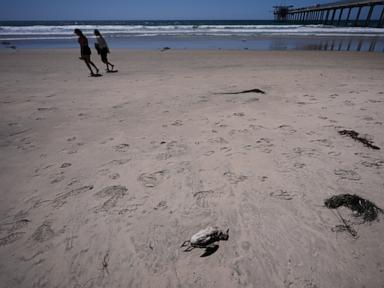
Walk onto almost any beach in Southern California right now and you will find them. Feathered carcasses mixed in with washed-up kelp. Emaciated bodies tucked under coastal rocks. It is a grim, heartbreaking sight.
Marine ornithologist Tammy Russell from the Scripps Institution of Oceanography recently went for a walk on a San Diego beach. Within minutes, she found one dead seabird after another. Local volunteers and scientists conducting monthly beach surveys are reporting the same nightmare up and down the coast.
This isn't a random, isolated freak accident. It's a massive, system-wide ecological collapse.
A severe marine heat wave is currently parked off the California coast. It has cooked the ocean surface for months, wiping out the cold, nutrient-rich waters that marine life depends on. To make matters worse, a powerful El Niño has officially formed in the Pacific. Scientists at the National Oceanic and Atmospheric Administration (NOAA) confirm it's growing toward historic strength.
The immediate result? Thousands of California brown pelicans, loons, grebes, and Brandt's cormorants are quite literally starving to death.
The Ectothermic Vise Starving Our Coast
If you look out at the ocean, everything seems fine on the surface. But underneath, the food web is fracturing.
Usually, strong winds along the California coast push warm surface water away from the shore. This allows deep, freezing, nutrient-packed water to rise to the top. This process is called upwelling. It acts like a fertilizer for the ocean, triggering massive blooms of phytoplankton. These tiny organisms feed fat-packed zooplankton, which then feed massive schools of forage fish like anchovies, sardines, and krill.
[Image of ocean upwelling process]
When a marine heat wave hits, this entire system shuts down. A thick layer of hot water sits on top of the ocean like a lid. The cold, nutrient-rich water can't break through.
Without nutrients, the plankton populations collapse. The forage fish that seabirds rely on for survival are forced to react. They have two choices: swim miles out to sea or dive deep into the dark, freezing depths where the heat wave can't reach them.
For the seabirds, both options are a death sentence.
The Limits of a Dive
Seabirds are incredible athletes. A common murre can dive deep to grab a fish, and pelicans can spot prey from high in the air. But they have physiological limits.
When bait fish plunge deep to escape the heat, they move way past the diving depth of many coastal birds. Cormorants and pelicans have to fly much further and search longer just to find a single meal. They burn through their energy reserves faster than they can replenish them.
Wildlife rehabilitation centers are seeing the consequences firsthand. The Santa Barbara Wildlife Care Network has been flooded with starving birds. Between January and June, they treated 91 sick and injured Brandt's cormorants. During the exact same period last year, they saw fewer than 20.
When these birds arrive at rescue facilities, they are emaciated, severely dehydrated, and suffering from hypothermia. Their bodies are so starved of calories that they can no longer regulate their own body temperature.
Why El Niño Will Make This Much Worse
If you think the current marine heat wave is bad, the immediate future looks downright terrifying.
Historically, massive die-offs happen once a decade. It's a natural cycle. But we are completely out of the normal cycle now. Ocean temperatures have been shattered by climate change, and the newly developed El Niño is about to dump a fresh surge of warm equatorial water directly into the mix.
Dan Robinette, a senior scientist at Point Blue Conservation Science, points out the trap these birds are caught in. Just as the current marine heat wave should be losing its grip and dissipating, El Niño is arriving to keep the water hot.
It is a back-to-back punch.
We have seen this script play out before, and it ends horribly. Back in 2014 to 2016, an unprecedented marine heat wave nicknamed "The Blob" took over the Northeast Pacific. It collided with a strong El Niño, creating an inescapable trap for marine life.
The data from that event is staggering:
- Over 62,000 dead common murres washed ashore between California and Alaska.
- Because most birds sink when they die at sea, scientists later calculated the actual death toll was closer to 1 million birds.
- A later study using colony counts up to 2022 estimated that 4 million murres died across the wider region during that multi-year heat event.
- Total reproductive failure hit 22 distinct seabird colonies. The birds were too weak to lay eggs, and the few chicks that hatched starved in their nests.
What we are seeing on California beaches right now is the opening chapter of the exact same horror movie.
The Juvenile Survival Crisis
There is another layer to this crisis that most people miss.
In 2025, California's seabirds actually had a highly successful reproductive year. Thousands of healthy chicks hatched and left their nests. But these juvenile birds are incredibly vulnerable. They don't have the years of hunting experience that adults do. They aren't as efficient at diving, and they don't know how to navigate a barren ocean.
When food vanishes from the shoreline, adult birds struggle, but juveniles completely fail. They don't have the fat reserves to survive weeks of empty hunting trips. The sudden spike in beach casualties we are seeing right now is heavily made up of these young, inexperienced birds that never stood a chance.
How to Help on the Beach
If you live along the California coast or plan to visit, you will likely cross paths with this crisis. You need to know what to do, because a wrong move can easily kill a stressed bird.
Look for the Warning Signs
A healthy seabird belongs in the water or on offshore rocks. If you see a cormorant, pelican, or grebe sitting completely still on dry sand, hiding under a pier, or walking inland toward parking lots, something is wrong.
Starving birds often lose their fear of humans because they are too exhausted to move. They will look tucked in, shivering, with their heads pulled tightly against their bodies.
Keep Your Distance
Do not try to catch the bird yourself. Pelicans have massive, powerful beaks that can easily inflict serious injury when they are frightened. More importantly, chasing a starving bird forces it to use up its absolute last drops of life-saving energy.
Keep children and dogs far away from the animal.
Call the Professionals
Your best move is to immediately contact local wildlife authorities. They have the training and transport enclosures to safely capture and stabilize emaciated birds.
- If you are in Southern California, call the Santa Barbara Wildlife Care Network or the International Bird Rescue in San Pedro.
- For Central and Northern California, contact the Pacific Wildlife Care or local SPCA wildlife centers.
- Save these numbers in your phone before you head to the coast.
If you find a bird that is already dead, do not touch it. Report the location to citizen science programs like BeachCOMBERS or the Coastal Observation and Seabird Survey Team (COASST). These organizations use public data to map out exactly how far the die-off stretches, giving scientists the data they need to track this ongoing crisis.