Ten years ago, an international tribunal in The Hague handed down a ruling that was supposed to redefine the South China Sea. It completely invalidated China’s expansive nine-dash line claim. It gave the Philippines a massive legal victory.
Fast forward to today. Beijing still calls that landmark 2016 arbitral award nothing more than a piece of waste paper.
If you're tracking the region's geopolitics, you're probably asking a fundamental question. How does Beijing expect to settle this mess if it completely rejects the law everyone else stands on?
The short answer is simple. Beijing doesn't want an international solution. It wants a series of one-sided deals managed entirely on its own terms.
As we hit the ten-year mark of the Hague ruling, China has put forward its own formula to solve the disputes. It’s a mix of bilateral bullying, strategic "gray-zone" pressure, and a rewritten historical narrative. Beijing's proposal isn't about compromise. It’s about forcing its neighbors to accept a fait accompli while freezing out Western powers.
But this strategy is running into a wall. Its neighbors aren't buying it anymore.
The Core of Beijing's Proposal
Beijing’s official position sounds reasonable on the surface. They talk about peaceful bilateral dialogue and joint development. They say the countries directly involved should sit down and hash things out without outside interference.
Look closer at what that actually means.
When Beijing insists on bilateral talks, it deliberately isolates smaller neighbors. Imagine a trillion-dollar economy sitting across the table from a country like Brunei or the Philippines. It isn't a negotiation. It's an exercise in asymmetry. China gets to dictate terms because it holds all the economic and military cards.
By blocking multilateral forums, China effectively defangs groups like ASEAN. Manila tried hard to push for a binding Code of Conduct through ASEAN. That effort petered out. Beijing systematically dragged its feet on the negotiations, ensuring that any final code would be too weak to matter.
Instead of a broad rules-based order, Beijing wants a web of individual, fragile deals. They want agreements like the temporary, unwritten understanding reached over the Second Thomas Shoal resupply missions. Those deals don't solve the core sovereignty issue. They just give China a veto over its neighbors' basic maritime operations.
Redefining the Legal Narrative
To make its proposal work, China has to destroy the legitimacy of the 2016 ruling. Over the last decade, it hasn't just ignored the decision. It has aggressively tried to replace it.
The Chinese Foreign Ministry and state media have stepped up a massive public relations push. They recently launched an elaborate propaganda video titled "What the South China Sea Waves Tell Us". The goal is clear. They want to paint the entire waterway as an inseparable part of ancient Chinese civilization. They want history to trump modern international law.
Chinese government scholars are taking things a step further. They are opening up entirely new fronts of dispute to distract from their weak legal standing. Recently, state-affiliated academics targeted the Batanes Islands, a northern Philippine province close to Taiwan. They claimed Manila lacks legal sovereignty over them.
This isn't random. It’s a calculated warning. If the Philippines continues to rely on the West and use the Hague ruling as a shield, Beijing will make life miserable elsewhere. It’s a classic gaslighting tactic on a geopolitical scale.
Beijing's Two-Pronged Strategy:
1. Legal Erasure -> Dismiss the 2016 Hague Ruling as an "absurd political manipulation" and "poisoned legacy."
2. Narrative Replacement -> Flood the zone with historical videos and challenge undisputed territories like the Batanes Islands.
The Failure of Coercion at Sea
While Beijing talks about peace, its actions on the water tell a completely different story. This is the teeth of their proposal. If a country refuses to negotiate bilaterally, China deploys its coast guard and maritime militia to make life unbearable.
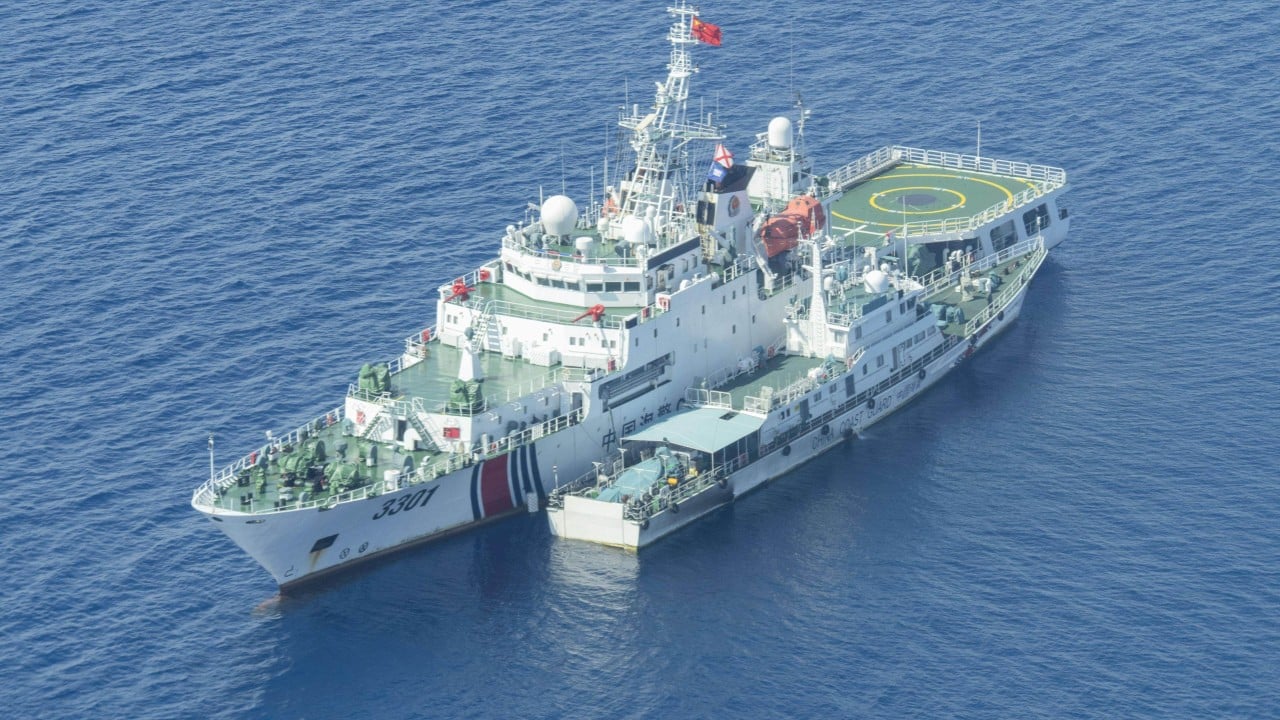
We've watched this unfold in real-time. Over the past few years, Chinese coast guard vessels have fired high-pressure water cannons at Philippine resupply ships. They have used blinding military-grade lasers against Filipino crews. They have rammed wooden supply boats.
Recent Flashpoints of Chinese Gray-Zone Activity:
- Scarborough Shoal: Deploying water cannons against fishery vessels and increasing fixed installations.
- Second Thomas Shoal: Confronting Philippine naval resupply attempts to the grounded BRP Sierra Madre.
- Antelope Reef: Launching new phases of heavy island-building construction in the Paracels.
Satellite imagery reveals that China’s island-building machine hasn't stopped. At Antelope Reef in the Paracels, construction is entering an advanced phase. Beijing is building its largest outpost in that sector.
This reveals the fatal flaw in Beijing’s proposed solution. It relies entirely on intimidation to force compliance. But instead of bowing down, its neighbors are pushing back harder than ever.
The Pushback and a New Coalition
Beijing expected the world to forget about the 2016 ruling. They thought a decade of economic pressure would make the legal victory irrelevant. They were wrong.
A massive 14-nation coalition recently issued a joint statement to mark the tenth anniversary of the award. The group included the United States, Japan, Australia, the United Kingdom, Germany, and Canada. They explicitly declared that the ruling remains final, legally binding, and definitive. The European Union came out with its own strong endorsement.
This furious international unity blindsided Beijing. It triggered a wave of angry diplomatic protests from the Chinese Foreign Ministry, which lashed out at Japan and the US for meddling.
Even more damaging to Beijing’s strategy is the fact that Southeast Asian nations are starting to bypass China completely. Look at the recent maritime cooperation deal between Manila and Hanoi. By negotiating directly with each other, the Philippines and Vietnam are rewriting the rules of engagement. They are showing that regional states can settle their own overlapping claims without letting Beijing dictate the terms.
What Happens Next
Beijing's proposed solution for the South China Sea is a dead end because it ignores the fundamental reality of modern international relations. You can't build a lasting security architecture on the premise that might makes right.
If you're looking for where this conflict goes tomorrow, keep your eyes on these specific tracking steps:
- Watch the Batanes Islands: See if China shifts its naval exercises or coast guard patrols farther north toward this new flashpoint.
- Monitor Joint Patrols: Track whether the 14-nation coalition transitions from verbal support to actual, regular naval operations inside the Philippines' exclusive economic zone.
- Track Vietnam's Next Move: Watch if Hanoi decides to file its own international arbitration case against China, using the Philippines' 2016 blueprint.