America just hit its 250th birthday, but nobody is agreeing on what exactly we're celebrating.
If you watched the political stage over the Independence Day weekend, you didn't see a unified nation reflecting on two and a half centuries of constitutional democracy. Instead, you witnessed two completely irreconcilable versions of what it means to be an American.
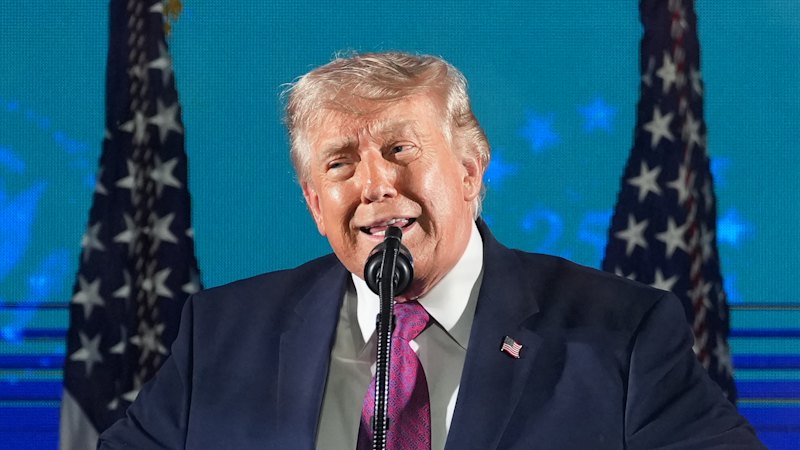
On one side, President Donald Trump stood before the granite faces of Mount Rushmore, delivering a fiery speech that framed the current national moment not as a celebration, but as a frontline battle against a "communist menace" lurking within our own borders. On the other side, rising Democratic stars like Maryland Governor Wes Moore used the holiday to pitch a masterclass in reclaiming patriotism from the populist right, arguing that loving America means wrestling with its deep flaws to build something better.
This isn't just standard partisan bickering. It's a deep existential conflict over the country's identity. Understanding this split is vital if you want to make sense of where American politics is heading as we sprint toward the critical 2026 midterm elections.
The Dark Rhetoric at the Mount Rushmore Fortress
Look at the imagery Trump chose for the eve of the Semiquincentennial. Mount Rushmore is monumental, static, and carved in stone. It represents a specific, unyielding version of American heritage.
Trump used this backdrop to deliver a warning that felt more like a wartime address than a birthday toast. He didn't focus on the abstract ideals of the 1776 declaration. He drew a sharp line in the sand. "You can be a communist, or you can be a patriot," Trump told the crowd. "You cannot be both."
Trump's Core 250th Message:
- American culture is under direct threat from internal radicals.
- Patriotism requires total loyalty to a specific cultural heritage.
- Political victory in the midterms is the only way to save the republic.
By explicitly labeling political opponents and newcomers who hold different values as a "mortal threat" greater than Pearl Harbor or 9/11, Trump did something deliberate. He tied the concept of American identity to cultural compliance. In this worldview, being American isn't about participating in a grand, messy experiment. It's about protecting a fortress from the people trying to change it.
He even used the platform to demand immediate legislative action, calling for the elimination of the Senate filibuster to pass the SAVE America Act. It was a raw, transactional pivot from national history to immediate electoral strategy.
Reclaiming the Flag on the Left
Meanwhile, Democrats are realizing that abandoning the symbols of patriotism was a massive strategic blunder. For years, the left has struggled with national messaging, often sounding like they're apologizing for America's existence rather than celebrating it.
Wes Moore's July Fourth address, titled "The Work of Patriotism," offered the direct counter-strategy. Moore didn't ignore America's historical sins. He openly acknowledged that our history is uneven, complicated, and deeply unfair to many.
But his conclusion was entirely different from the progressive mainstream. He argued that true patriots are the ones who put the flag on their shoulders precisely because they want to fight for a better tomorrow.
This view treats American identity as an active verb. It's a project that is never finished. To Moore, patriotism isn't about defending a static, perfect past; it's about the uncomfortable work of making the nation live up to its founding promises. It's an attempt to decouple the flag from conservative nationalism and prove that you can love a country while actively trying to fix its systemic bugs.
Why This Ideological Chasm Matters to You
This split impacts everything from local school board elections to federal immigration policy. We're no longer arguing about tax rates or infrastructure spending. We're arguing about the baseline definition of the nation.
When one half of the country views the other half as an existential threat akin to foreign invaders, democratic compromise becomes impossible. Trump's rhetoric functions by building a wall around the definition of a "true" American. Moore's strategy attempts to broaden that definition, but it faces the uphill task of convincing a skeptical, cynical electorate that institutions are still worth saving.
If you're trying to figure out how to navigate this polarized climate, you need to look past the fireworks and the staged backdrops. The real fight of 2026 isn't over who gets to hold the gavel in Congress next year. It's over who gets to write the narrative of the next 250 years of American history.
Active Steps for Navigating Polarized Politics
Don't let the toxic national rhetoric paralyze your civic engagement. You can actually do a few practical things right now to see past the noise.
- Read the source texts directly. Don't rely on cable news snippets. Go find the full transcripts of Trump's Mount Rushmore speech and Moore's holiday address. Look at the specific words they use to define accountability and freedom.
- Track local midterm data. National politicians use grand philosophical arguments to rile up donors. Look at your local ballot measures for the upcoming midterms to see how these abstract identity wars are being weaponized into actual laws in your community.
- Support localized civic projects. The national narrative is broken, but local institutions usually aren't. Spend your energy on community-level historical or civic groups where people still talk to each other like neighbors instead of enemies.

:max_bytes(150000):strip_icc()/TAL-nassau-bahamas-BEAUTCARIB0323-4fbfce903e5a4418b895e03717e3de0d.jpg)