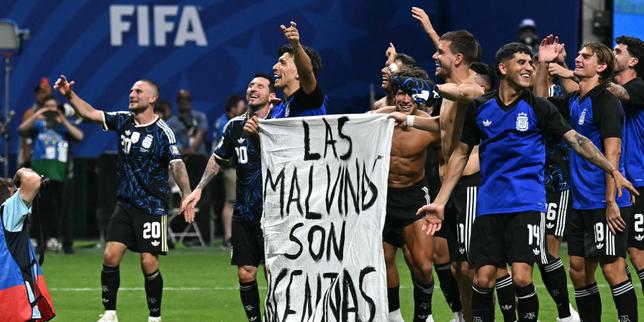
The final whistle had barely blown when the real drama started.
Argentina had just beaten England in a highly anticipated match at the 2026 World Cup. On the pitch, the celebrations were wild. But within minutes, the story shifted from tactical brilliance and late-match heroics to a piece of light blue and white fabric. Don't forget to check out our earlier coverage on this related article.
Several prominent players from the Albiceleste squad gathered behind a banner. It read, in bold and unmistakable letters: "Las Malvinas son argentinas." The Falklands are Argentine.
It was a deliberate, coordinated political statement broadcast to hundreds of millions of screens worldwide. Within seconds, social media fractured into predictable camps. One side called it a glorious display of national pride. The other side called it a classless, illegal provocation that violated the very core of international sportsmanship. If you want more about the background of this, CBS Sports offers an excellent summary.
But if you view this as a simple, cheap taunt to wind up English fans, you are missing the point entirely. This is about a deep-seated historical trauma, an unresolved territorial claim, and a national identity that uses football as its primary emotional outlet.
The Post Match Flashpoint
Football matches between Argentina and England are never just football matches. The history is too thick. The tension is too real.
When the players unfurled that banner on the pitch, they knew exactly what they were doing. They knew the television cameras would zoom in. They knew the images would flash across news outlets from Buenos Aires to London within seconds.
This was not a spontaneous outburst. It was a planned demonstration. To understand why modern athletes, who earn millions playing in Europe and have seemingly little connection to a brief war fought in 1982, would risk FIFA sanctions, you have to look at how Argentina teaches its history.
In Argentina, the claim over the Falkland Islands—which they call the Malvinas—is not some fringe political opinion. It's literally written into their national constitution. It's taught in every single primary school. Kids grow up singing songs about the islands. Soldiers who died there are revered as national martyrs.
When an Argentine player puts on that blue and white jersey, they carry that historical weight. Beating England on the pitch is the closest thing to historical correction they can get.
Why the Falklands Still Burn in the Argentine Soul
The conflict over these wind-swept islands in the South Atlantic lasted just 74 days in 1982. It ended with a decisive British victory, the surrender of Argentine forces, and the loss of around 900 lives, mostly young Argentine conscripts.
It was a military disaster for the ruling Argentine junta, leading to their eventual collapse and the return of democracy. But the end of the dictatorship did not mean the end of the claim. If anything, the democratic governments of Argentina doubled down on the rhetoric.
Argentine Conscripts Lost: 649 lives
British Service Members Lost: 255 lives
For Argentines, the war is a wound that never properly healed. The British administration of the islands is seen as a colonial relic, a geographical absurdity where a European power controls territory just off the coast of South America.
To the British, it's a settled matter. The people living on the islands—the Kelpers—voted overwhelmingly in a 2013 referendum to remain a British Overseas Territory. The vote was not even close. Out of more than 1,500 votes cast, only three people voted against staying British.
This is the classic, unyielding deadlock. On one hand, you have the principle of self-determination. On the other hand, you have the principle of territorial integrity.
When those two principles clash on a football pitch, things get messy.
Maradona and the Great Football Substitution
You cannot talk about Argentina, England, and the Falklands without talking about Diego Maradona in 1986.
Four years after the war, the two nations met in the quarterfinals of the World Cup in Mexico. What happened in those ninety minutes became the stuff of sports legend. Maradona scored his infamous "Hand of God" goal, followed minutes later by the "Goal of the Century," where he bypassed almost the entire English defense.
Maradona later admitted in his autobiography that the match was a symbolic war. He wrote that while they claimed before the game that football had nothing to do with the Malvinas War, they knew deep down that Argentines had been killed there. He wrote that they were playing for those fallen boys.
That 1986 match established a precedent. In the minds of Argentine football fans and players, the pitch became a legitimate arena for geopolitical retribution.
The current squad of players, most of whom were born long after 1982 and even after 1986, grew up on this narrative. It's a legacy passed down through generations. When they beat England, the urge to assert their national claim is almost instinctual.
The Hard Law of FIFA
While the players might feel justified by history, the governing body of world football is not known for its historical romanticism.
FIFA has incredibly strict rules regarding political displays. Law 4 of the Laws of the Game clearly states that equipment must not have any political, religious, or personal slogans, statements, or images. This rule extends from the players' undergarments to banners displayed on the field after the final whistle.
Furthermore, Article 11 of the FIFA Disciplinary Code targets anyone who uses a sports event for demonstrations of a non-sporting nature.
FIFA's stance is simple. They want a sanitized, politically neutral commercial product. They want sponsors to feel safe. They want to avoid international diplomatic incidents that could disrupt their multi-billion-dollar tournaments.
We have seen this play out before.
In 2014, before a friendly match against Slovenia in La Plata, the Argentina national team displayed a similar "Las Malvinas son argentinas" banner. FIFA did not hesitate. They launched an investigation and hit the Argentine Football Association (AFA) with a fine of 30,000 Swiss Francs.
But a 30,000-franc fine for a friendly match is one thing. Doing it at the 2026 World Cup, with the eyes of the world watching, is a completely different level of defiance.
FIFA is now under massive pressure to act decisively. The English Football Association is reportedly furious and has already lodged a formal complaint. If FIFA lets this slide with a slap on the wrist, they open the floodgates for every other geopolitical dispute to play out on their pitches. Think of Spain and Gibraltar, Armenia and Azerbaijan, or Kosovo and Serbia.
The Myth of a Neutral Pitch
This entire incident highlights a massive contradiction in modern sports.
Governing bodies like FIFA and the International Olympic Committee love to push the narrative that sports and politics should not mix. They want you to believe that the pitch is a sacred, neutral space where the troubles of the world vanish for ninety minutes.
It is a nice fantasy. But it is completely detached from reality.
Sports are inherently political. They are built on national anthems, national flags, and national identities. You cannot leverage the passionate, tribe-like loyalty of nationalism to sell tickets and TV rights, and then act shocked when that same nationalism spills over into political expression.
When Swiss players of Albanian descent, Granit Xhaka and Xherdan Shaqiri, made the double-eagle gesture against Serbia in 2018, it was political. When Celtic fans wave Palestinian flags, it's political. And when Argentine players bring out a banner about the Malvinas, it is political.
Players are not robots programmed to perform athletic feats and then quietly return to the dressing room. They are human beings shaped by their culture, their upbringing, and their national myths.
Where Argentina and FIFA Go From Here
The Argentine Football Association is currently preparing its defense, but they have a weak hand to play. They will likely argue that the display was a spontaneous expression of national identity and not meant as a political provocation.
It won't work. The banner was too large, too professional, and the timing was too deliberate.
Here is what is likely to happen next:
- A Heavy Financial Penalty: The AFA will face a massive fine, significantly larger than the one in 2014, to act as a deterrent.
- Player Suspensions: Individual players caught holding the banner could face multi-game bans, which could severely impact Argentina's progress in the rest of the tournament.
- Formal Apologies: FIFA may demand a formal statement from the Argentine federation distancing themselves from the political message.
For England, the best response is to let the governing bodies handle it. Any official retaliation or angry statements from British politicians will only validate the Argentine narrative that this is an ongoing, active conflict.
Ultimately, this incident shows that some historical wounds are too deep for time, or football, to heal. The pitch is not a neutral zone. It is a mirror of the world, reflecting all of its triumphs, its tragedies, and its unfinished business.