You have probably heard the grand stories of how ancient civilizations suddenly appeared, conquered lands, and replaced the people living there. But real history is rarely that neat. In fact, it is usually a lot messier, local, and buried deep inside a highly dense skull bone.
For the longest time, extracting usable genetic material from the southern Levant was considered nearly impossible. The intense heat and high humidity of the region act like a slow-motion shredder for organic material. But a salvage excavation at a heavily damaged First Temple-era tomb near Abu Ghosh, just west of Jerusalem, changed that.
Against the odds, scientists managed to pull the first direct ancient DNA from individuals culturally identified as ancient Israelites. The results do not show a massive wave of outside conquerors. Instead, they tell a completely different story: one of deep, local survival.
The Race Against Modern Construction
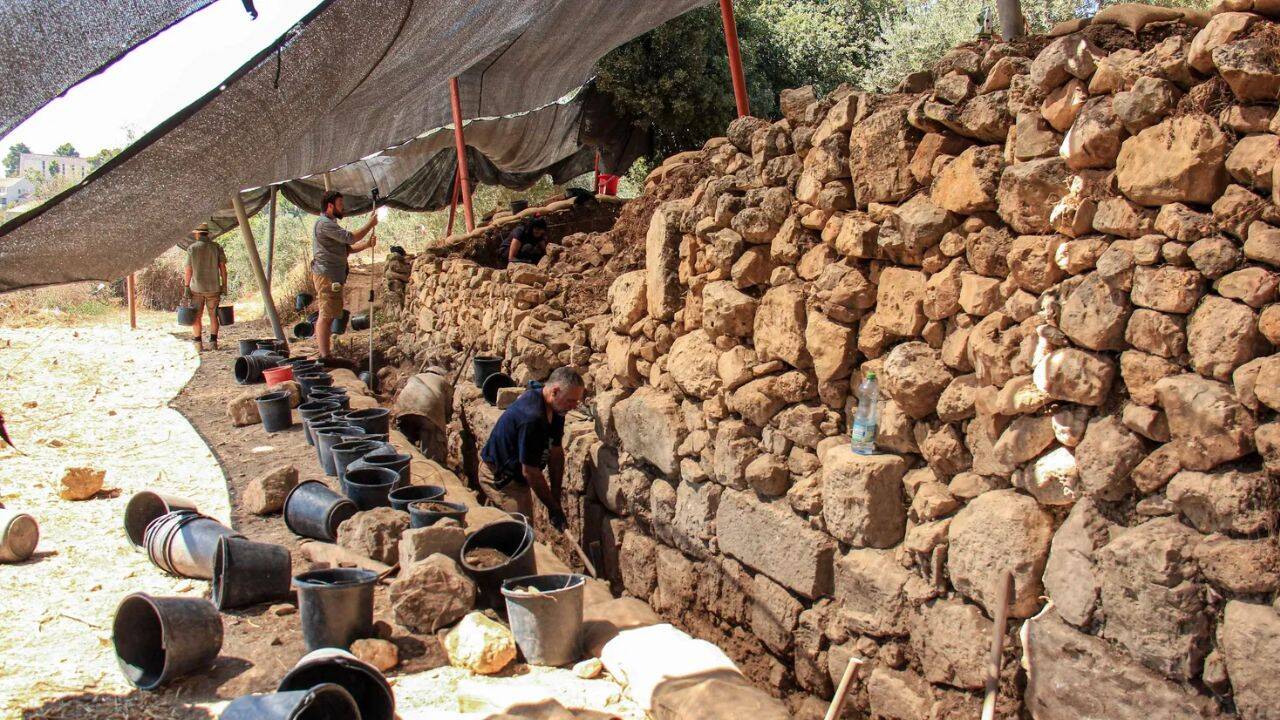
Before the archaeologists even showed up at the site near Kiryat Yearim, modern life had already taken a heavy toll. Construction crews and looters had hacked right through parts of the ancient stone burial chamber. What was left was a chaotic mix of broken pottery, displaced soil, and fragmented human skeletons.
A salvage excavation team stepped in to save what they could. They recovered the shattered pieces of about 150 pottery vessels alongside the bones of multiple adults and children. Based on the style of the ceramics and the layout of the chamber, experts dated the site to the late Iron Age, roughly between 750 and 650 BCE. This puts the tomb squarely within the final centuries of the Kingdom of Judah.
Because the tomb was used for generations, the bones were completely mixed up. This was not a pristine royal crypt. It was a family burial site that had been disturbed for thousands of years by both ancient relatives and modern bulldozers.
Cracking the Toughest Vault in the Human Body
How do you get fragile, 3,000-year-old genetic data out of bones that have been baked by the Middle Eastern sun and smashed by machinery? You ignore the long limb bones and head straight for the ears.
Geneticists focused on the petrous bone. It is a dense, rock-like segment of the temporal bone that houses the inner ear. Because it is so hard, it protects microscopic structures from the elements better than any other part of the skeleton.
A team involving geneticist David Reich and archaeologist Israel Finkelstein managed to isolate partial genetic codes from two individuals in the tomb—one male and one female. The data was limited, consisting mostly of mitochondrial sequences and Y-chromosome markers. These lines only show a narrow window of direct maternal and paternal heritages, but what they revealed was massive.
- The Paternal Line: The male individual carried the Y-haplogroup J2. This marker is historically common across the Near East, Anatolia, and the Caucasus.
- The Maternal Lines: The team identified the mitochondrial haplogroups T1a and H87, lineages deeply rooted in early Near Eastern history.
Cultural Identity Versus Genetic Code
It is easy to jump to conclusions and declare that we have found the definitive "Israelite gene." But science demands a lot more caution. The tomb itself did not come with an inscription or a nameplate.
We label these individuals as ancient Israelites because of where they were found and how they were buried. The pottery shapes, the geographic location just outside Jerusalem, and the multi-generational family burial style perfectly match the known cultural habits of the Kingdom of Judah.
But culture does not equal genetics.
The DNA markers show clear continuity with much older Bronze Age Canaanite populations. For decades, a major debate has simmered in archaeology: Did the ancient Israelites sweep into the region from somewhere else, or did they grow out of the local population?
This new genetic data points firmly to the latter. The people buried in this tomb were genetically linked to the regional populations that had lived in the Levant for thousands of years. They did not arrive as part of a massive, clean population replacement. They were the locals, adopting a new cultural and political identity as the Kingdom of Judah grew.
The Iron Age Reality
History books love clean borders, but the ancient Levant was highly fluid. Trade routes crossed the hills of Jerusalem, and local elite families likely shifted their political allegiances depending on who held the most power at the time.
The Kiryat Yearim data suggests that despite the violent political shifts of the Iron Age—including the heavy hand of the Assyrian Empire in the late 8th century BCE—the genetic foundation of the everyday population remained remarkably steady. The people who built the First Temple-era culture were the literal descendants of the Bronze Age people who preceded them.
Your Next Steps to Exploring Levantine History
If you want to look past the headlines and understand how ancient genetics actually works, skip the sensationalized articles and go straight to the sources that matter.
- Check out the primary databases: Look up the published work of the David Reich Lab at Harvard University to see how ancient DNA is mapped across West Asia.
- Explore the geography: Search for maps of the ancient Kingdom of Judah and locate Kiryat Yearim (Abu Ghosh) to see just how close this site sat to the political heart of Jerusalem.
- Read up on the Bronze Age Collapse: To understand why the transition from Canaanite to Israelite identity happened, research the systematic systems crash that hit the Mediterranean around 1200 BCE.
The story written in our bones is rarely about total isolation. It is about staying put while the world changes around you.