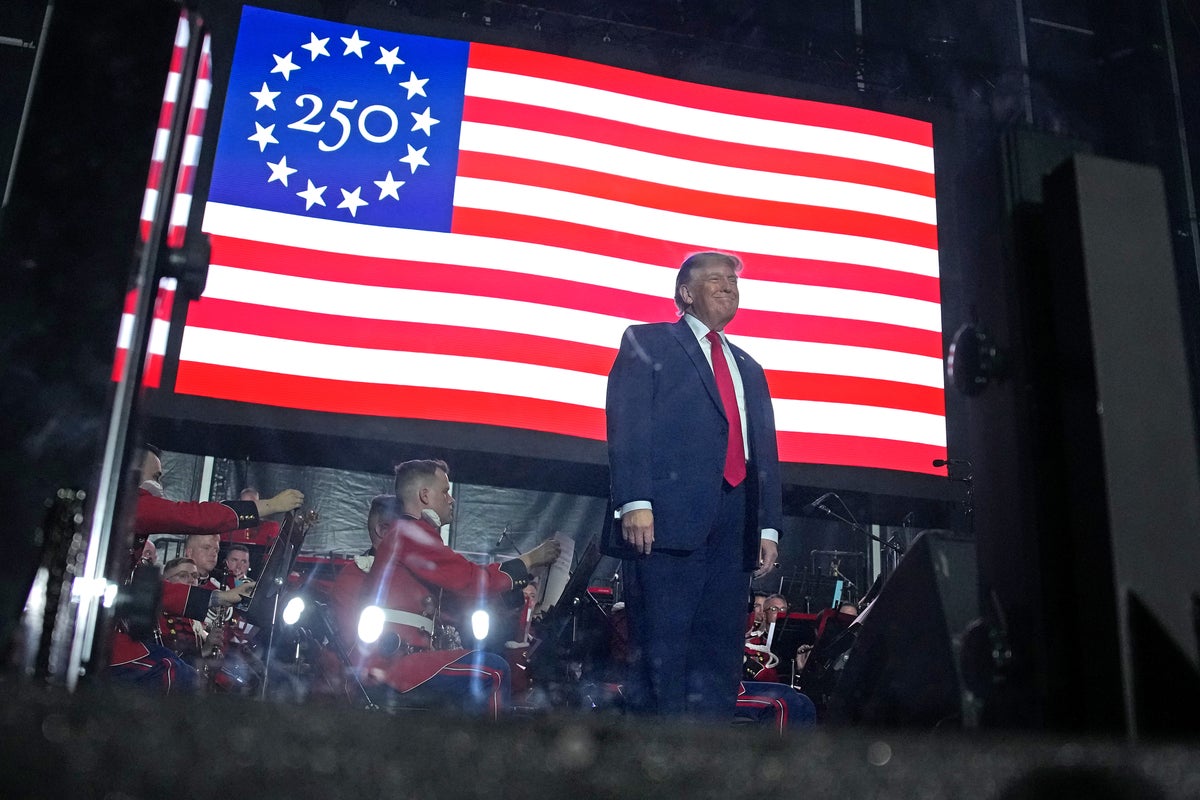
Walk around Washington right now and you can't miss it. Massive banners featuring Donald Trump's face hang from federal buildings. Down on the National Mall, crowds are sweating through 100-degree heat for the "Freedom 250" Great American State Fair. It's July 4, 2026, the official 250th anniversary of the United States.
But behind the fireworks and the multi-million-dollar pyrotechnics, a strange historical paradox is unfolding. The nation is celebrating its break from an absolute monarch while its current leader holds a level of legal immunity and executive control that would make King George III envious.
This isn't just partisan hyperbole. It's the reality of a transformed American legal landscape. A series of recent Supreme Court rulings has completely rewritten the rules of American governance, systematically dismantling the very checks and balances the founders put in place to prevent a king. When Trump stands on stage today to mark two and a half centuries of American independence, he does so with more concentrated personal authority than any president before him.
The Supreme Court rewrote the rules of power
To understand how we got here, look at the legal framework established just before this anniversary. The traditional view of the presidency was simple: the president enforces the laws passed by Congress, and nobody is above the law.
The conservative majority on the Supreme Court flipped that idea on its head.
First came the 2024 immunity decision, shields-up protection for any action deemed an "official act." If a president uses the Department of Justice to target political rivals or orders the military to take controversial domestic action, it's virtually impossible to prosecute them.
Then came the hammer blow in the recent Trump v. Slaughter decision. The high court fully embraced the "unitary executive theory." This isn't some dry academic concept anymore; it's active policy. The ruling gives the president near-total authority over independent federal agencies.
For nearly a century, presidents couldn't just fire the heads of regulatory bodies like the Federal Trade Commission or the Federal Reserve on a whim. Congress deliberately set them up to be insulated from political interference. Not anymore. The court threw out that precedent. If an official refuses to follow a direct, politically motivated directive, the president can simply fire them and install a loyalist.
Worse than a monarchy
The liberal wing of the Supreme Court didn't hold back in its dissent. Justice Sonia Sotomayor wrote a blistering opinion, noting that the court has granted the executive "a power unknown even to the English Crown against which the Founders revolted." Justice Ketanji Brown Jackson argued the conservative majority has consistently twisted legal theories to ensure the current administration always wins.
Think about the complaints listed in the original 1776 Declaration of Independence. Thomas Jefferson complained that King George III had made the military superior to civil power, altered the forms of government, and refused to assent to laws.
Yet under the current legal interpretation:
- The president has complete immunity for official military deployments on domestic soil.
- Independent agencies designed to protect consumers and stabilize the economy can be bent to the executive's personal will.
- The civil service can be systematically dismantled and replaced by political appointees through a revived spoils system.
Trump himself doesn't see this as a threat to liberty. Speaking to supporters in North Dakota just days before the anniversary, he openly praised the shift, stating the decisions give "power back to the president at a time when the president really needs power."
The battle for the narrative of 1776
The irony is baked right into the anniversary celebrations. Congress originally set up a non-partisan commission called "America250" back in 2016 to plan this milestone. The goal was a broad, historically grounded reflection on American progress, featuring input from historians, cultural institutions, and all fifty states.
Instead, the administration sidelined that effort, replacing it with the highly politicized "Freedom 250" task force. Rather than exploring the complex nuances of American history, the official programming plays out like a massive, executive-branded rally. We see "Freedom Trucks" rolling across 48 states, historical videos focusing heavily on military dominance, and a master-planned fair on the Mall that feels more corporate and centralized than public and democratic.
While Vice President JD Vance stands aboard the USS Kearsarge in New York Harbor praising George Washington for securing a free republic, the actual mechanics of that republic are shifting beneath our feet. The founders were obsessed with avoiding tyranny. They created three equal branches of government to keep each other in check. Right now, the judicial branch has willingly handed its own leverage over to the executive.
What happens next
The legal reality is set. You don't need to guess how this power will be used; the blueprint is already being executed.
If you want to understand where American governance is heading for the rest of 2026 and beyond, stop looking at the rhetoric of the fireworks displays and look at the actual operational shifts happening in Washington:
- Watch the civil service purges: Keep a close eye on structural changes within federal agencies. The administration now has the legal green light to strip protections from career civil servants, turning independent experts into political employees.
- Track the weaponization of the DOJ: With criminal immunity firmly established for official duties, watch how federal law enforcement is directed. The barrier between independent justice and political retribution has effectively vanished.
- Monitor the regulatory rollback: Watch the actions of previously independent boards like the FCC and the SEC. Their independence is gone. If they don't align with executive dictates, their leadership will be replaced immediately.
America at 250 is not the America of 1776. The rebellion against a king succeeded, but the guardrails built to keep another one from rising have been systematically disassembled by the highest court in the land.