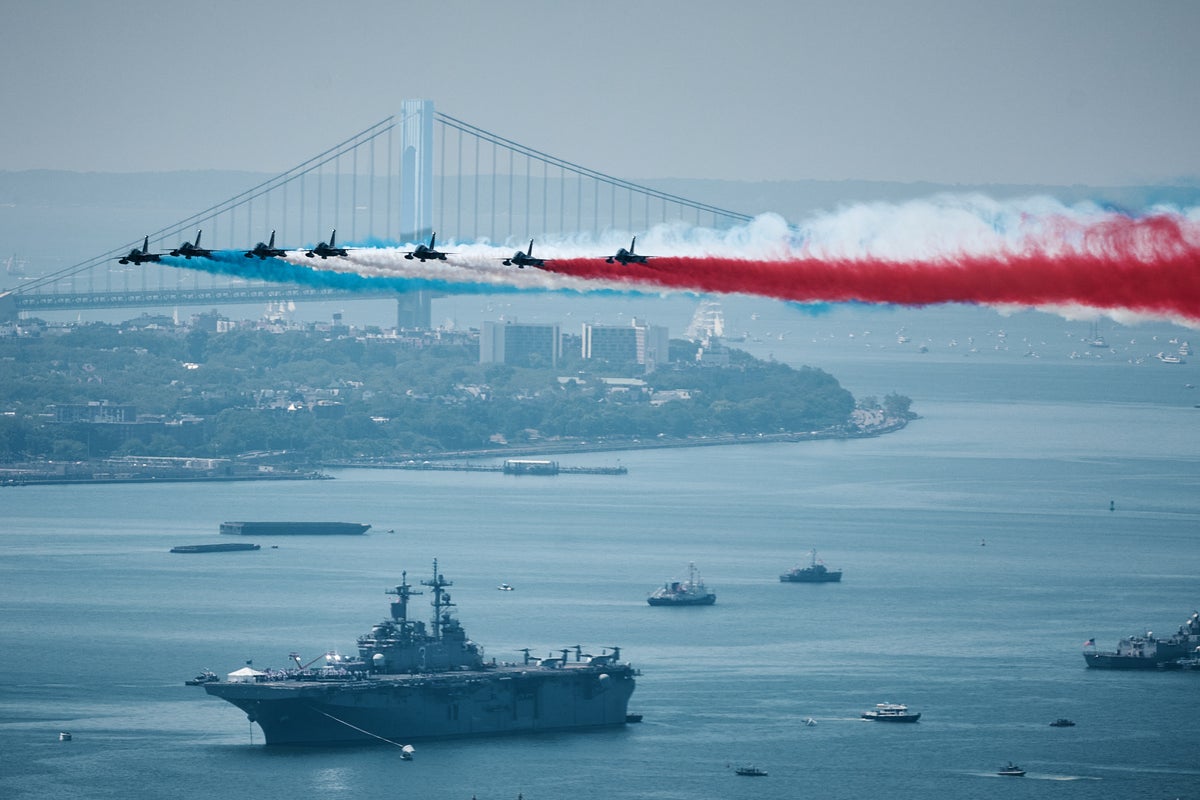
Hundreds of military aircraft tore through the skies above Washington DC, leaving streaks of red, white, and blue against a stifling, heavy haze. Down on the ground, the pavement radiated a blistering 100 degrees Fahrenheit. If you looked closely at the National Mall, the crowds weren't the ocean of spectators organizers had spent years dreaming about. They were a scattered, sweating assembly of die-hards ducking under whatever shade they could find. America reached its 250th birthday on July 4, 2026, but the milestone didn't bring the grand moment of national unity people hoped for. Instead, it served up a perfect snapshot of a nation wrestling with record-breaking heat, intense political warfare, and a deep identity crisis.
We all knew the Semiquincentennial would be big. The Trump administration promised a spectacle that would eclipse anything before it. What we actually got was a surreal mix of jaw-dropping pyrotechnics, canceled daytime events, and a highly partisan political rally. For a deeper dive into this area, we recommend: this related article.
A Record Heatwave and Broken Traditions
You can't talk about this anniversary without talking about the oppressive weather. A massive, historic heatwave parked itself over a huge swath of the United States just in time for the holiday weekend. In the nation’s capital, temperatures soared past 38 degrees Celsius, pushing the heat index into dangerous territory.
It completely wrecked the scheduling. Cities across the East Coast had to make tough calls. In Washington, local officials canceled early daytime events entirely to keep people from dropping of heatstroke. The grand parades that usually fill the morning hours vanished. Instead, emergency services urged everyone to stay inside until sunset. Even the main event, the "Salute to America 250" show, had its timeline pushed back to late evening. To get more background on this topic, extensive analysis can be read at Al Jazeera.
Then came the threat of severe evening thunderstorms. The high humidity didn't just make people miserable; it cooked up unstable atmospheric conditions. Organizers kept a nervous eye on radar screens all afternoon, knowing a sudden downpour could ruin a multi-million dollar setup.
New York managed to dodge some of the worst daytime disruption by launching its festivities when the sun was down. The city ushered in the Fourth with a spectacular midnight ball drop in Times Square, intentionally mirroring the classic New Year’s Eve tradition. It was a clever move, but it couldn't mask the fact that across most of the country, celebrating required a high tolerance for physical danger.
The Battle for the Nation's Soul on the National Mall
The real friction wasn't in the atmosphere. It was on the stage. Donald Trump turned the federal city into the backdrop for what he openly promoted as a spectacular political event. The organizational structure behind the anniversary tells the whole story. A private-public partnership called Freedom250, backed directly by the White House, took over the reins of the celebration. They pushed aside the original, bipartisan America250 commission that Congress had set up a decade ago.
Democrats were furious. They accused the president of hijacking a collective national milestone to boost his own image ahead of the upcoming November midterm elections. California Senator Alex Padilla didn't mince words, publicly stating that the president couldn't help but make the country's 250th birthday entirely about himself.
Trump leaned straight into the controversy. Earlier in the week during a speech at Mount Rushmore, he set the tone by warning crowds of an ongoing communist threat to the nation. By the time he hit the stage at the National Mall around 9:45 PM, he was ready to deliver on his promise of a really long speech. He used the platform to project strength, mock his critics, and pitch his vision of American heritage.
The hyper-political framing carried immediate consequences. Several high-profile musical acts quietly pulled out of the lineup shortly after their participation went public. They didn't want the brand fallout of performing at what looked less like a national birthday party and more like a campaign rally. Freedom250 officials dismissed the criticism as a partisan smear, but the damage to the event's universal appeal was already done.
A Massive Pyrotechnic Distraction
If the speeches divided the crowd, the night sky was designed to blind them to those divisions. The administration went all-out to secure a Guinness World Record for the largest official fireworks show in human history.
The scale of the display was genuinely staggering:
- 850,000 total fireworks shells prepared for launch.
- 10 separate launch sites spread across Washington DC.
- 8 massive barges positioned strategically along the Potomac River.
- 40 full minutes of continuous, thunderous explosions.
Compare that to a normal D.C. Fourth of July display, which typically uses about 20,000 shells and lasts roughly 20 minutes. This was a massive logistical undertaking. The skies lit up in a relentless barrage of color and sound that you could hear miles into Virginia and Maryland.
Yet, even this spectacular show couldn't escape scrutiny. Environmental groups raised serious alarms about the sheer volume of particulate matter dumped into the air. With the air already stagnant due to the intense heatwave, the massive smoke cloud from 850,000 shells created localized air pollution concerns that lingered long after the final boom.
Beyond the Capital's Political Circus
Away from the political theater of the National Mall, other parts of the country found ways to honor the day with less partisan tension. The standout alternative happened in the waters around New York and New Jersey.
The Sail4th 250 festival brought a majestic maritime gathering to the Hudson River. It featured an incredible international fleet that brought real global participation to the American milestone.
- 32 different countries sent vessels to participate.
- 15,000 international sailors flooded the regional ports.
- Legendary tall ships like Colombia's ARC Gloria, Peru's BAP Unión, and Portugal's Sagres drew massive crowds at the piers.
Walking down to Brooklyn Bridge Park or the South Street Seaport gave you a completely different feeling than looking at the National Mall. It felt international, historic, and focused on maritime tradition rather than modern electoral politics. Families lined the banks to watch these historic vessels glide past the Statue of Liberty, accompanied by coordinated aerial flyovers trailing colored smoke. It proved that Americans still wanted to celebrate the milestone; they just didn't all want the version being sold in Washington.
A Divided Nation Facing a Mirror
You can't understand the strange energy of this anniversary without looking at the data. The national mood in the summer of 2026 is remarkably low. The fireworks were loud, but the underlying anxieties are louder.
Recent polling numbers from Gallup paint a stark picture of where our collective heads are at. An astonishing eight out of ten Americans believe the Founding Fathers would be deeply disappointed by the current direction of the country. Furthermore, 59% of the population believes that the nation's best years are firmly behind it.
This isn't just one side complaining about the other. The pessimism cuts right across the political spectrum. Conservatives see a nation losing its traditional values and economic edge. Liberals see a democracy under siege and basic rights eroding. When both sides look at the flag, they see two entirely different countries. The 250th anniversary didn't heal that wound; it just put a giant spotlight on it.
Finding Comfort in the Beautiful Game
Strangely enough, the biggest source of genuine collective pride this summer isn't coming from historical reflection or political speeches. It's coming from soccer stadiums.
The United States is currently co-hosting the 2026 FIFA World Cup. The timing couldn't be better. Just days before the holiday, the U.S. Men's National Team secured a thrilling 2-0 victory over Bosnia and Herzegovina in the Round of 32 at the San Francisco Bay Area Stadium. Folarin Balogun scored a crucial goal right before halftime, and Malik Tillman sealed the win late in the second half, despite the team playing a man down after Balogun picked up a red card.
The deep run in the tournament is doing something the politicians can't: it's making people cheer together. Packed watch parties in cities nationwide have brought a messy, chaotic, but real sense of shared joy. When the national team wins on the global stage, the political tribalism fades into the background, if only for 90 minutes.
Where We Go From Here
The party is over, the smoke has cleared, and the extreme heat is still baking the asphalt. So, what do we do with a milestone that felt so fractured?
First, stop waiting for a single, magical event to unite the country. Washington is going to stay messy, and the political class will keep using history as a weapon for the next election cycle. The real celebration of a quarter-millennium of independence doesn't live in a 40-minute fireworks display or a scripted speech.
If you want to actually process what this milestone means, look at the local level. Check out the visiting international tall ships open to the public in New York through July 7. Support local historic preservation societies that tell the messy, complete story of how your own community evolved over the last two centuries. Most importantly, channel that energy into civic action. Register to vote for the upcoming midterms, engage with your neighbors outside of social media echoes, and recognize that a 250-year-old experiment is always a work in progress. The future isn't written yet, and sitting around mourning the past won't fix the road ahead.