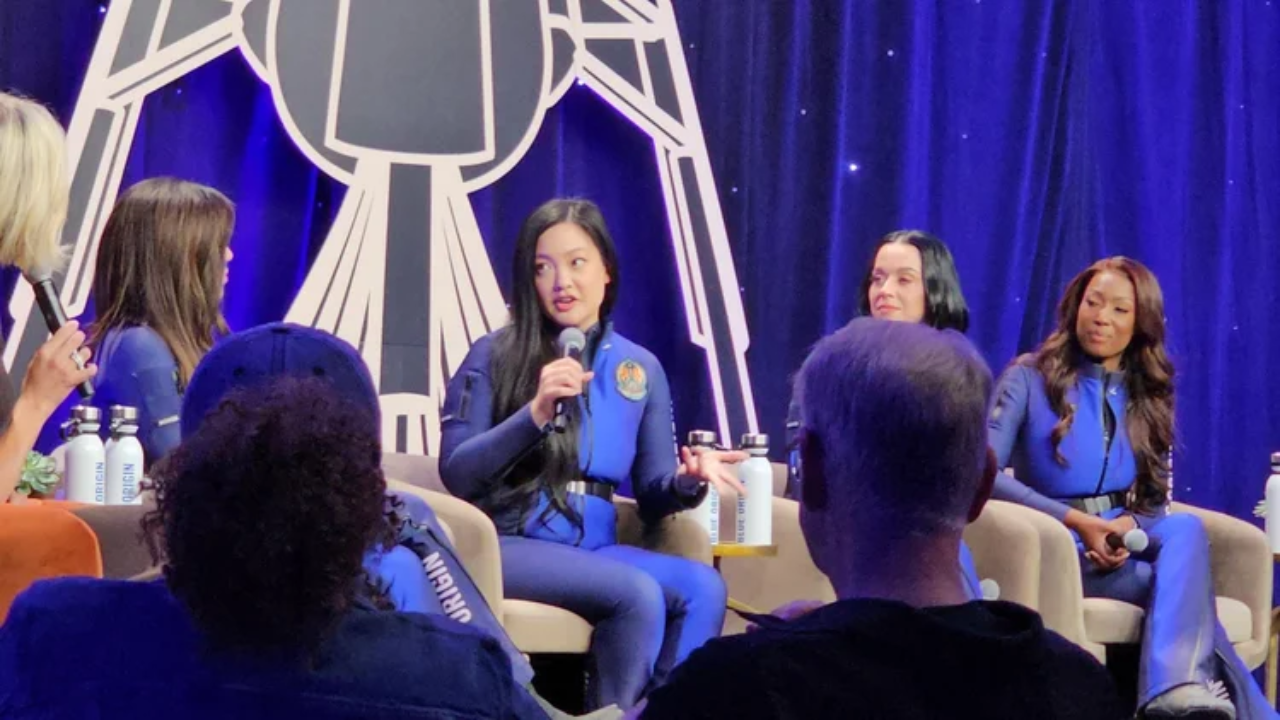
When Blue Origin launched its NS-31 mission on April 14, 2025, the internet didn't look at the sky and see a breakthrough. It looked at the screen and saw a meme. The media coverage focused heavily on the glamour and the celebrity high-fives. You probably saw the clips of pop star Katy Perry and TV anchor Gayle King celebrating their ten-minute suborbital ride. You might have read the online commentary mocking billionaires buying PR wins.
But if you only watched the viral clips, you missed the most important person on that spacecraft.
Amanda Nguyen became the first Vietnamese and Southeast Asian woman to cross the Kármán line into space. Her presence on that flight wasn't a vanity stunt or a corporate favor. For Nguyen, those eleven minutes in microgravity represented the culmination of a lifelong dream that was brutally derailed, a decade of relentless civil rights battles, and a refusal to let the worst moment of her life define her horizon. While others were there for the ride, Nguyen brought actual science, deep cultural legacy, and a massive middle finger to a historical system that told her she didn't belong.
From Star Maps to Broken Systems
Long before she became a household name in advocacy, Nguyen was obsessed with the stars. The daughter of Vietnamese boat refugees who fled the aftermath of the Vietnam War, she grew up listening to stories of how her parents navigated open waters by tracking constellations. That generational connection to the night sky sparked something permanent.
She went to Harvard University to study astrophysics. She spent her college years tracking exoplanets at the Harvard-Smithsonian Center for Astrophysics and securing competitive internships at NASA. She worked on projects like the Kepler exoplanet mission and data analysis for STS-135, which was the final space shuttle flight. She was on a direct, unyielding trajectory toward becoming a professional astronaut.
Then, during her final year at Harvard in 2013, she survived a brutal sexual assault.
When you go through something that traumatic, you expect the law to have your back. Nguyen didn't find justice; she found a bureaucratic nightmare. When she opted to have a rape kit collected, she chose to file it anonymously as a "Jane Doe" while she processed the trauma. She quickly discovered that the state of Massachusetts would routinely destroy untested rape kits after just six months if a survivor didn't formally request an extension.
The system gave her no clear instructions on how to file that extension. It didn't notify survivors before burning the evidence. The state essentially forced survivors to choose between constantly re-traumatizing themselves by chasing paperwork every six months or letting their shot at legal justice be permanently erased.
Nguyen realized that the legal system was fundamentally broken for survivors. Her mentors and attorneys told her she had to make a choice. She could either spend years fighting a grueling, multi-year legal battle that would likely tank her career, or she could move on.
She chose a third option. She decided to rewrite the law.
The Birth of Rise and Citizen Lawmaking
In November 2014, Nguyen founded Rise, a nonprofit organization run entirely by volunteers. She didn't have corporate backing or deep political connections. She started with a GoFundMe page and a massive group email sent to every professor, classmate, and acquaintance she knew, asking them to help her pen a new framework for justice.
The goal was simple but massive. Rise wanted to create a federal Sexual Assault Survivors' Bill of Rights. They wanted to guarantee basic, undeniable protections, like the right to have a rape kit preserved for the entire duration of the statute of limitations without charge, and the right to be notified before that evidence gets destroyed.
Most people told her she was wasting her time. Washington was paralyzed by partisan gridlock. Getting a piece of civil rights legislation passed through Congress seemed completely impossible for a young woman in her twenties with zero political experience.
Nguyen proved everybody wrong. She treated lawmaking like an engineering problem. She broke down the legislative process into cold, hard metrics. She trained volunteers to use data, clear communication, and persistent outreach to pressure lawmakers on both sides of the aisle.
The strategy worked with historic efficiency. In October 2016, President Barack Obama signed the Sexual Assault Survivors' Rights Act into law. It had passed through both the U.S. House of Representatives and the Senate with completely unanimous votes. A twenty-four-year-old scientist had managed to push through a federal law that protected the civil rights of millions of people without a single dissenting vote.
Her work didn't stop there. Rise took that model to state legislatures across America and to the United Nations. To date, the organization has helped pass dozens of laws across the United States, establishing protections for over 84 million survivors. Her sheer effectiveness earned her a nomination for the Nobel Peace Prize in 2019 and a spot as one of Time magazine's Women of the Year in 2022.
But even as she changed the world on Earth, she never stopped looking back up at the stars.
The Real Science Behind the NS-31 Flight
When private spaceflight companies talk about democratization, it usually means wealthy people buying tickets. Nguyen didn't have millions of dollars to drop on a suborbital joyride. Her seat on the Blue Origin NS-31 flight was partially sponsored by Space for Humanity, a nonprofit dedicated to sending impact-driven leaders into space so they can bring that global perspective back to their communities.
While the media focused on the celebrity spectacle of the April 2025 flight, Nguyen treated the mission exactly like an astronaut should. She brought serious research objectives on board, collaborating directly with scientific institutions.
Testing Women's Health in Microgravity
Historically, space agencies ignored or minimized female biology. Early in the space race, NASA leadership actively blocked women from entering the astronaut corps, frequently using lazy, unscientific excuses about menstruation and hormonal fluctuations to justify the exclusion.
Nguyen used her time in weightlessness to confront those old biases directly. In her role as a researcher at the International Institute for Astronautical Sciences, she conducted microgravity fluid dynamics experiments. She tested the absorbency and behavioral properties of sustainable, bamboo-based sanitary materials in zero gravity. It sounds basic, but data on how menstrual fluids behave in space is still remarkably sparse because the industry was run by men for decades.
Medical and Botanical Research
Nguyen also tested a wearable ultrasound patch and next-generation spacesuit materials engineered by researchers at the Massachusetts Institute of Technology, where she previously served as a Media Lab Fellow. She conducted an experiment focused on how microgravity affects wound-healing materials, which is crucial data for long-duration space missions where medical emergencies have to be handled without a hospital.
She carried 169 lotus seeds provided by the Vietnam National Space Center. These seeds traveled with her past the Kármán line and back down to Earth. Scientists are now studying how exposure to space conditions and brief microgravity affects the pathology and growth of these plants. It wasn't just a nod to her heritage; it was an effort to contribute to agricultural space science for Southeast Asian research institutions.
Why the Timing of the Mission Matters
The flight took off from West Texas just weeks before a massive historical milestone. April 2025 marked exactly fifty years since the end of the Vietnam War and the Fall of Saigon.
For the daughter of boat refugees to enter space at that exact moment carries immense weight. Her parents fled a war-torn country on packed boats, looking at the night sky just to find a safe heading toward freedom. Exactly half a century later, their daughter sat in a rocket, broke through the atmosphere, and looked down at the entire planet from the edge of space.
Nguyen has been incredibly vocal about this timeline. She frequently points out how quickly a family can move from survival to global impact when given the opportunity. Her journey is a living example of turning systemic exclusion into a historic seat at the table.
How to Apply the Lessons of Her Journey
You don't need a degree from Harvard or millions of dollars in venture capital to make a dent in the world. If you look closely at how Nguyen operates, she provides a clear blueprint for forcing change when the odds are stacked against you.
- Stop waiting for permission. Nguyen didn't wait for an established politician to notice the flaws in the justice system. She realized nobody was going to write those civil rights for her, so she sat down and wrote them herself. If you see a systemic flaw in your local community, school, or workplace, draft the solution yourself.
- Treat advocacy like science. Passion is great, but execution wins. Treat your goals like an engineering problem. Break down your objective into actionable steps, track your progress with clear metrics, and ignore the noise.
- Refuse to abandon your deferred dreams. Life will throw massive, devastating detours in your path. Nguyen had to step away from her aerospace ambitions for years to build Rise and fight for survivors. She didn't let that pause become a permanent stop. She kept training, kept researching, and eventually made it to space on her own terms.
If you want to support her ongoing efforts, you can get involved with Rise to learn how to draft and pass laws in your own state. You can also support organizations like Space for Humanity that work to ensure space exploration isn't just an exclusive playground for the ultra-wealthy, but a platform for leaders who actually bring value back down to Earth.