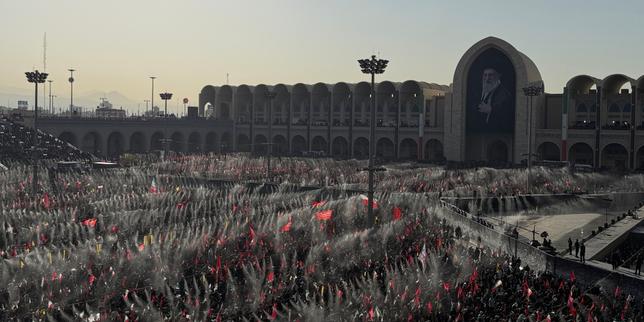
Thousands of black-clad mourners are packing into the Imam Khomeini Grand Mosalla in Tehran right now. It is the second day of the national funeral for Ali Khamenei, the late Supreme Leader of Iran. Most Western media coverage focuses on the sea of flags, the tears, and the synchronized chest-beating. They look at the spectacle. They miss the real story.
You want to know what is actually happening behind closed doors in Iran today, July 5, 2026. You want to understand what this massive public display means for the stability of the Middle East and the future of international diplomacy.
The Iranian regime is using this six-day mourning ritual as a highly calculated theatrical display of strength. This is not just a funeral. It is a desperate assertion of political survival after four months of devastating conflict. Khamenei was killed back on February 28 during the opening salvo of the war. Delaying his funeral until the weekend of the 250th anniversary of American independence was a deliberate choice. It was designed to maximize geopolitical friction.
The Invisible Successor and the Struggle for Authority
If you watch state television broadcasts from the Grand Mosalla, you see high-ranking figures crowding near the caskets. President Masoud Pezeshkian is there. Parliament Speaker Mohammad Bagher Ghalibaf is there too, standing prominently near the flag-draped box topped with Khamenei’s iconic black turban.
But look closer at who is not there.
Mojtaba Khamenei, the 56-year-old son who was quickly named the new Supreme Leader back in March, is completely invisible. He has not appeared in public since the funeral events began. Rumors are flying through the capital. Some intelligence reports suggest he was severely injured in the very same strikes that killed his father. Others believe he is hiding out of pure survival instinct, terrified of another targeted attack.
This absence creates a massive credibility problem for the regime. You cannot project absolute control when your new supreme ruler is too afraid or too incapacitated to stand beside his father’s body. Instead, men like Ghalibaf, who leads the ceasefire negotiation team with Western powers, are filling the visual void. This shifts the focus from spiritual revolution to raw, desperate political survival.
Engineering Solidarity Under a Scorching July Sun
The regime claims that up to twenty million people will flood the capital during this week of ceremonies. The streets surrounding the Mosalla are completely shut down. Airspace over Tehran is locked tight. Volunteers are frantically spraying water over tightly packed crowds to prevent mass heatstroke in the intense summer heat.
The government has deployed over four hundred Red Crescent tents across Tehran. Water trucks and ambulances line the avenues. They are treating hundreds of citizens who are collapsing from exhaustion.
This level of logistics shows how much the state needs this event to succeed. They need the world to see a unified front. To do this, they are relying heavily on busing in loyalists from rural provinces, offering free transport and meals.
Inside the Mosalla, the caskets of four of Khamenei’s family members sit on a black platform built to resemble the Kaaba in Mecca. The imagery is heavy, religious, and intense. People are chanting for revenge. Red flags symbolizing blood feuds are everywhere.
But this intense displays of grief do not tell the whole story of the Iranian public.
What Lies Beneath the Public Performance
Don't let the state-managed crowds fool you. Tehran is a deeply divided city, and beneath the surface of this state funeral lies a massive wave of resentment.
Many residents are choosing to stay home, turning the city into a ghost town outside the immediate funeral zone. For a massive portion of the population, particularly the youth who led the internal protests earlier this year, Khamenei’s death brought a sense of relief rather than sorrow.
Think about the families of those killed by state security forces during the anti-government crackdowns over the last few years. To them, the sight of millions of dollars being spent on a six-day state funeral while the economy collapses under the weight of war is an insult.
The state has forced the Tehran Grand Bazaar, local gyms, and private businesses to close down for the mourning period. This forced closure is costing regular citizens their livelihoods at a time when inflation is skyrocketing. The regime is forcing solidarity, but forced solidarity always has an expiration date.
The Geopolitical Fallout and What Happens Tomorrow
This funeral has paused the delicate, behind-the-scenes negotiations between the United States and Iran aimed at ending the current war. Both sides agreed to a temporary, one-week de-escalation in the Strait of Hormuz to avoid an accidental flare-up while Tehran is distracted.
Foreign delegations are using their presence in Tehran to signal where they stand in this fractured global order. Former Russian President Dmitry Medvedev arrived to show Moscow's continued alignment with Iran. Pakistani Prime Minister Shehbaz Sharif and delegations from Iraq, Hamas, and the Taliban are also walking through the Mosalla. Even Saudi Arabia sent a formal delegation, a move that shows just how fragile regional diplomacy is right now.
The funeral procession will not stay in Tehran for long. Tomorrow, Monday, the body moves to the holy city of Qom. From there, the regime is taking the high-risk step of moving the caskets across the border into Iraq, planning stops at the major Shia holy sites in Najaf and Karbala. This is a clear attempt to assert Iranian religious influence over neighboring Iraq before the final burial takes place in Mashhad on Thursday.
Your Next Steps to Track This Crisis
The situation in Iran is changing rapidly, and you need to look past official state media to get the true picture. Here is how you should analyze the coming days.
First, monitor whether Mojtaba Khamenei makes an appearance before the final burial in Mashhad on Thursday. If he remains hidden, it signals profound instability or physical incapacitation within the highest level of the state apparatus.
Second, watch the borders of Iraq closely over the next forty-eight hours. Moving the body of an Iranian leader through Iraqi cities like Najaf is highly controversial and could trigger major local counter-protests from Iraqis who reject Iranian dominance.
Third, keep an eye on the expiration of the one-week maritime de-escalation agreement. The moment this funeral ends, the paused diplomatic channels will face their toughest test yet, and any misstep will restart full-scale regional hostilities. Stay critical of the images coming out of Tehran. The crowd is large, but the cracks in the foundation are larger.