Archaeologists expect to find broken pottery, corroded coins, and crumbling mudbricks during routine survey work. They don't expect pure Mediterranean marble to start poking out of the mud on the final day of an excavation.
That's exactly what happened near the coastal town of Binyamina in northern Israel. Field crew members working on a routine salvage project ahead of a major railway expansion stumbled upon two remarkably intact marble busts from the Roman era. The sculptures weren't sitting in a grand palace or a marble temple. Workers found them stuffed face-down inside the filtration pit of a disused ancient winepress.
The find immediately raised heavy questions across the archaeological community. Why would someone carefully hide pristine imperial-era art inside an agricultural vat? Who were these carved faces meant to represent? The details behind this discovery offer a clear window into how ancient elites lived, how political conflict forced families to hide their treasures, and how modern infrastructure projects keep rewriting regional history.
The Shocking Find on the Last Day of Digging
It happened right when crews were preparing to pack up their gear. The Israel Antiquities Authority (IAA) was managing a salvage excavation funded by Israel Railways. The goal was straightforward: clear the ground near Binyamina so contractors could double the coastal train tracks running between Tel Aviv and Haifa.
Field manager Michael Sorotskin and his team had spent weeks clearing a sprawling Byzantine-era wine production complex. They logged standard finds like storage jars, loose coins, and shards of utility glass. On the very last day of field operations, a worker noticed something hard protruding from the soil inside a stone-lined wine collection pit.
"There was a feeling that we were about to discover something that really shouldn't be there," Sorotskin noted after the excavation wrapped up.
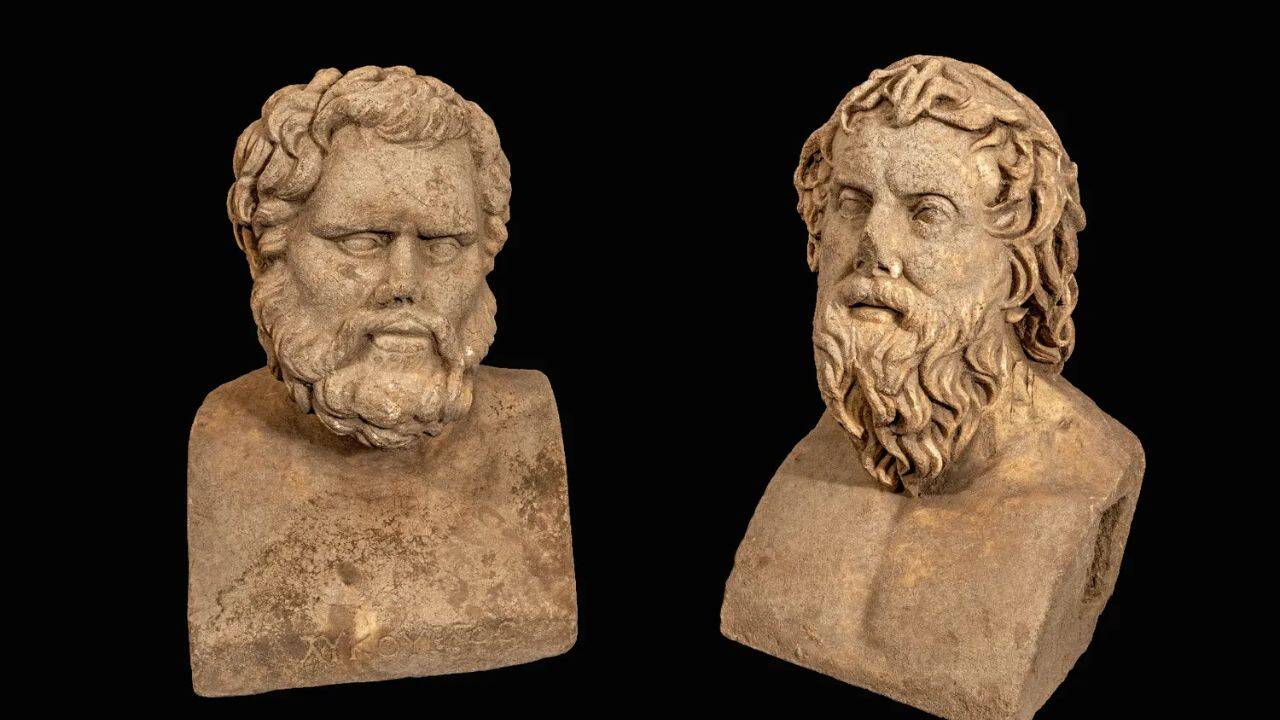
When workers cleared away the packed dirt, the pale surface didn't look like ordinary local terracotta. It was high-grade imported marble. As the crew cleared away more dirt, two fully sculpted heads and upper torsos—known technically as protomes—emerged from the ground side-by-side. Each piece stood nearly 22 inches tall and weighed around 132 pounds. Except for a chipped nose on one figure, both sculptures were almost entirely intact.
Finding intact marble art in this region is remarkably rare. Sculptures from the Roman world were usually smashed during religious shifts or crushed into lime kilns to make mortar for later construction projects. Discovering two pristine pieces resting face-down in a drainage vat was completely unexpected.
Deciphering the Faces in the Pit
The two statues represent distinct figures from the classical past, but identifying them with absolute certainty has proven tricky.
The Inscribed Bust of Lycurgus
One of the busts provided an immediate clue. Carved clearly into its side was a Greek inscription reading "Lycurgus."
That single name opens up two plausible historical candidates:
- Lycurgus of Sparta: The legendary, semi-mythical lawgiver who established the militaristic laws and social institutions of classical Sparta between the 11th and 8th centuries BCE.
- Lycurgus of Athens: The famed fourth-century BCE orator, financier, and statesman who managed Athenian state finances and championed civic rebuilds.
Roman aristocrats were obsessed with Greek culture. Wealthy landowners frequently decorated their private villas and bathhouses with portraits of Greek statesmen, philosophers, and military heroes. Placing a portrait of a legendary figure like Lycurgus in a private residence was the ancient equivalent of displaying fine art to show off one's education, political ties, and social standing.
The Unnamed Bearded Philosopher
The second bust carries no inscription at all. It features a man with a heavy beard, deeply set eyes, and distinguished facial lines.
In Roman portraiture, a full beard almost always signaled intellectual ambition. Around the early second century CE—particularly during the reign of Emperor Hadrian—beards became fashionable across the empire as a nod to Greek philosophy and high culture. IAA experts believe this unnamed figure represents a renowned thinker, teacher, or orator whose likeness was widely copied across Mediterranean studios.
The Timeline Problem and Why the Sculptures Were Hidden
The mystery isn't just about who the statues depict. The timeline of where they were found presents an even bigger puzzle.
Statistical and stylistic analyses date the marble busts to the late second or third century CE, during the height of Roman power in Judaea. The winepress where they were buried, however, was constructed centuries later during the Byzantine period, between the fifth and seventh centuries CE.
That means the sculptures were already centuries-old antique heirlooms when someone placed them in the ground.
Archaeologists Eliran Oren and Avishag Reiss pointed out that the deliberate positioning of the statues tells a clear story. They weren't discarded as trash. They weren't dumped haphazardly. Someone laid them carefully face-down, side-by-side, at the bottom of the wine collection pit after the winepress had stopped functioning for processing grapes.
Why go through the trouble of burying 260 pounds of marble in a wine pit?
- Hiding from Religious Riots: During the Byzantine era, Christianity became the official imperial religion, and fanatical groups frequently targeted pagan imagery, classical statues, and polytheistic symbols. Owners may have buried these classical portraits to save them from destruction.
- Protection from War and Raids: The region saw frequent military upheaval, regional revolts, and political instability. Wealthy families often concealed valuable heirlooms in agricultural pits, intending to recover them once the danger passed.
- Preventing Theft: High-quality imported marble was extraordinarily expensive in the ancient Levant, where local limestone dominated standard building projects. Burying the art protected it from looters during times of crisis.
Whoever hid the statues never made it back to dig them up. The secret remained buried beneath the soil of northern Israel for roughly 1,400 years until a modern railway project brought them back to light.
Connecting the Finds to Roman Caesarea
To understand why luxury marble ended up in an agricultural field near Binyamina, you have to look at the surrounding geography.
Binyamina sits just six miles inland from ancient Caesarea Maritima. Built by Herod the Great and later turned into the capital of the Roman province of Judaea, Caesarea was a bustling Mediterranean port filled with theaters, palaces, hippodromes, and lavish seaside villas.
The countryside surrounding Caesarea was filled with suburban estates owned by high-ranking Roman officials and wealthy merchants. Previous excavations near the Binyamina site revealed the foundations of an ancient bathhouse. Dr. Peter Gendelman, an IAA specialist on the Caesarea district, notes that these statues almost certainly belonged to a luxury villa connected to that bathhouse complex.
The owner of this estate likely ran an agricultural operation—producing wine and olive oil for export through Caesarea's port—while enjoying the luxuries of a Roman estate furnished with imported Greek marble.
How Modern Infrastructure Uncovers Ancient History
This discovery highlights how development projects drive modern archaeology. Across Israel and the broader Mediterranean, law requires salvage excavations before heavy machinery breaks ground on modern highways, residential units, or train lines.
Without the project to double the coastal railway tracks, this winepress complex would have remained buried under agricultural fields. Infrastructure digs regularly yield major discoveries because they force teams to examine areas that haven't previously been flagged as major historical monuments.
These excavations balance modern development needs with historical preservation. Developers fund the digs, archaeologists clear the sites, and the public gains access to forgotten artifacts that would otherwise remain lost forever.
How to See the Statues and What to Do Next
If you want to track this discovery and explore similar Roman-era history firsthand, here are practical steps you can take today:
- Visit the Eretz Israel Museum (MUZA): The two marble busts were moved to Tel Aviv for public display at MUZA following their initial cleaning and stabilization. Check the museum's current exhibition schedule before visiting to confirm public viewing hours.
- Explore Caesarea National Park: Visit the coastal ruins of Caesarea Maritima, located a short drive from the Binyamina excavation site. Walk through the ancient Roman theater, the imperial port structure, and the restored bathhouse complexes to see where artifacts like these were originally displayed.
- Follow Official Excavation Updates: Stay updated on current salvage digs and recent finds through the official Israel Antiquities Authority portal and public archaeological reports.
The Binyamina busts prove that ancient history isn't just locked away in books. Sometimes, it's resting just a few feet below our feet, waiting for a construction crew to dig in the right spot.
Learn more about the discovery through this Ancient intact and magnificent marble statues, 1700 years old, were discovered adjacent to Binyamina news report showing footage of the artifacts and the excavation site.
This on-site video report provides immediate visual context showing how the two busts were positioned inside the ancient winepress pit at Binyamina.